
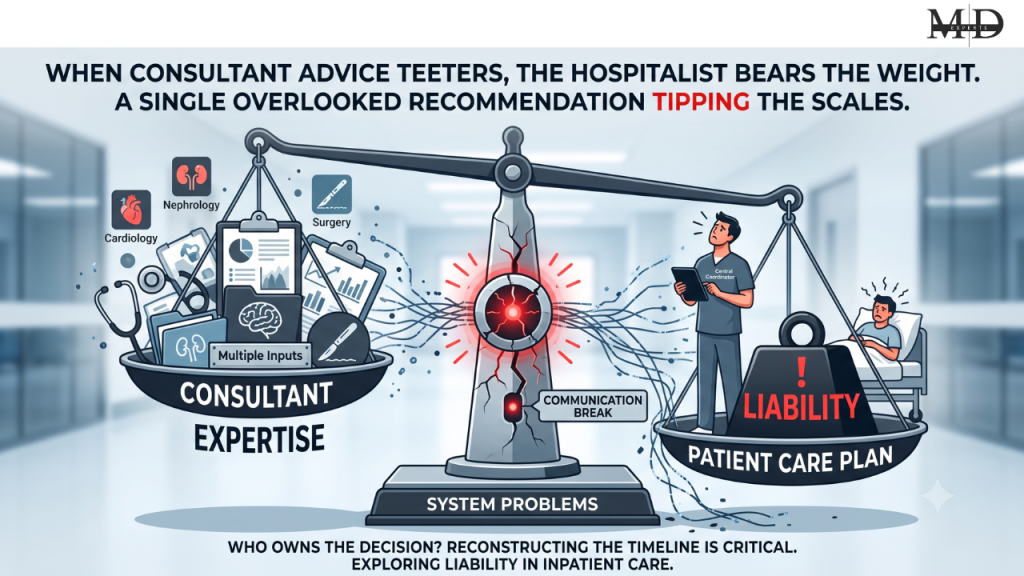
Hospital medicine depends on coordinated communication. A hospitalist may manage the patient’s overall inpatient care, but specialists and consultants frequently provide critical recommendations that influence diagnosis, treatment, procedures, monitoring, and discharge planning. When those recommendations are unclear, incomplete, delayed, misunderstood, or never acted upon, the resulting patient harm can create difficult questions about medical liability.
Consultant communication malpractice is particularly challenging because responsibility may be distributed among multiple physicians and care teams. Determining who was responsible for recognizing, communicating, documenting, and acting on important clinical information requires a careful review of the entire sequence of events.
The Communication Gap Between Consultants and Hospitalists
Hospitalists routinely coordinate care among emergency physicians, surgeons, intensivists, subspecialists, nurses, pharmacists, therapists, and other healthcare professionals. Consultants may evaluate a patient once or periodically, while the hospitalist remains responsible for managing the broader inpatient course.
This arrangement can create opportunities for specialist hospitalist miscommunication.
For example, a consultant may recommend:
- Additional diagnostic testing
- Medication changes
- Specific monitoring or follow-up
- A procedure or intervention
- A change in activity or diet
- A specialist follow-up appointment
- Escalation of care if certain symptoms develop
The recommendation may appear in the medical record, be communicated verbally, or be conveyed through a combination of both. Problems arise when the recommendation is ambiguous, not documented clearly, communicated to the wrong person, or not incorporated into the patient's treatment plan.
The Joint Commission identifies effective hand-off communication as an important patient-safety issue and emphasizes the need for processes that allow information to be exchanged between the healthcare professionals involved in a patient's care.
How Consultant Recommendations Can Become a Liability Issue
A consultant's recommendation does not automatically transfer responsibility away from the hospitalist. Likewise, the hospitalist is not necessarily responsible for every decision made by a specialist.
The central question in a malpractice case may be whether each clinician acted within the applicable standard of care based on the information available to them.
Consider a situation in which a cardiologist recommends additional cardiac monitoring but the recommendation is not clearly communicated to the hospitalist. The patient subsequently deteriorates, and the recommended monitoring was never initiated.
A subsequent claim might examine:
- What exactly did the consultant recommend?
- When was the recommendation made?
- To whom was it communicated?
- Was it documented in the medical record?
- Was the hospitalist aware of the recommendation?
- Was the recommendation clinically appropriate?
- Did the hospitalist have an independent duty to recognize the need for the intervention?
- Was there an opportunity to identify and correct the communication failure?
- Did the communication failure contribute to the patient's injury?
These questions demonstrate why consultant recommendations liability cannot be determined simply by identifying which physician made the recommendation.
Common Forms of Interservice Communication Failure
Interservice communication failure can occur in several ways.
1. Unclear recommendations
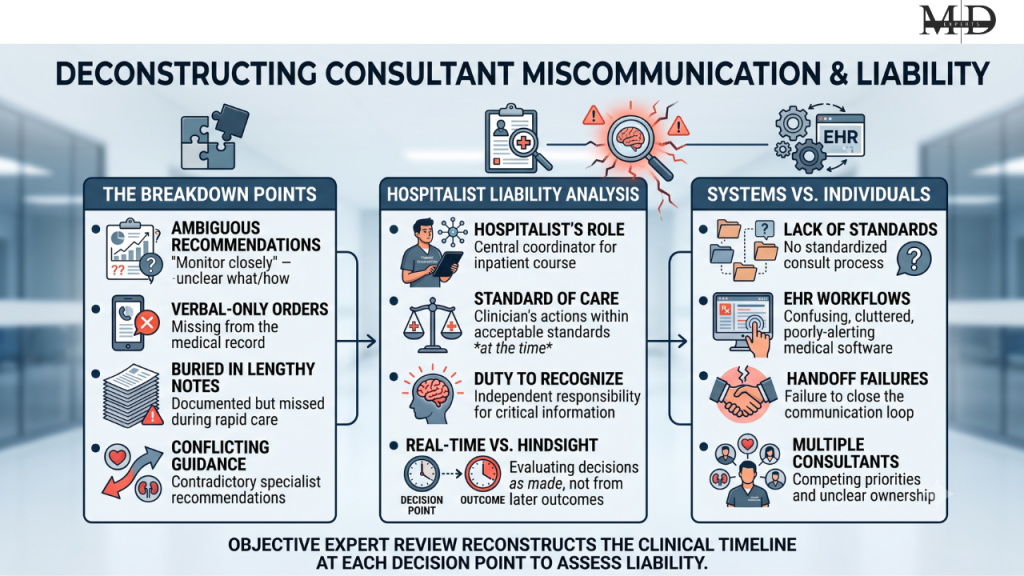
A consultant may document that a patient should be "monitored closely" without specifying what should be monitored, how frequently, or what findings should trigger escalation.
Ambiguous language can become particularly problematic when the patient's condition changes.
2. Verbal recommendations that are not documented
A consultant may communicate an important recommendation verbally but fail to document it. The hospitalist may later have difficulty determining exactly what was recommended.
When the patient's condition deteriorates, the medical record may provide little evidence about what information was exchanged.
3. Recommendations documented but not communicated effectively
Documentation alone does not necessarily establish effective communication.
A recommendation buried in a lengthy progress note may not reach the clinician responsible for acting on it, particularly when the patient's condition is changing rapidly.
4. Conflicting recommendations
Different specialists may provide recommendations that are inconsistent with one another. Without clear communication about which recommendation takes priority, the hospitalist may be left to reconcile conflicting clinical guidance.
5. Failure to close the communication loop
A consultant may recommend additional testing without confirming that the test was ordered, completed, or reviewed.
Similarly, a hospitalist may request a consultation without ensuring that the consultant's recommendations have been received and incorporated into the treatment plan.
6. Failure to communicate changes in patient condition
Communication problems are not limited to consultant recommendations. If the hospitalist or nursing team identifies a significant change but the consultant is not informed promptly, an opportunity for intervention may be lost.
Why the Hospitalist May Still Face Liability
Hospitalists often serve as the central coordinator of inpatient care. That role can make them particularly important when communication breaks down.
Research examining malpractice claims involving hospitalists has identified communication deficiencies as a contributing factor in a substantial proportion of claims. One study found communication was a contributing factor in 36.4% of hospitalist malpractice claims in its database.
Importantly, this does not mean that a hospitalist is automatically liable whenever a consultant makes an error.
Instead, liability analysis should examine the hospitalist's own conduct.
For example, if a consultant's recommendation was clearly documented and the hospitalist failed to review or act on it despite having a reasonable opportunity to do so, the hospitalist's conduct may become relevant.
Conversely, if the consultant provided an incorrect recommendation and the hospitalist reasonably relied upon it without having a reason to question it, the analysis may be very different.
What Medical Records Can Reveal
In a consultant communication malpractice case, the medical record can become one of the most important sources of evidence.
An expert reviewing the case may examine:
- Consultant notes
- Hospitalist progress notes
- Consultation requests
- Nursing documentation
- Medication orders
- Diagnostic test orders and results
- Secure messages and electronic communications
- Telephone documentation
- Procedure notes
- Discharge summaries
- Changes in the patient's clinical status
- Timing of recommendations and interventions
The objective is not simply to determine whether communication occurred. It is to reconstruct what was communicated, when it was communicated, who received it, and what happened afterward.
Hindsight Can Complicate Liability Analysis
Medical malpractice reviews should distinguish between information that was reasonably available at the time and information learned only after the patient's outcome was known.
A consultant or hospitalist may make a reasonable clinical decision based on the patient's condition, available test results, and information communicated at that moment. The fact that the patient subsequently experienced an adverse outcome does not, by itself, establish negligence.
This is why retrospective review requires careful attention to the timeline.
A strong expert analysis should consider the clinical information available at each decision point rather than evaluating the care solely through the lens of the eventual outcome.
Communication Failures Can Be System Problems
Not every communication failure is solely the result of an individual physician's conduct.
Hospital systems may contribute to communication problems through:
- Lack of standardized consultation processes
- Unclear responsibility for following recommendations
- Poorly designed electronic health record workflows
- Inadequate handoff procedures
- Multiple competing consultants
- Staffing or workload issues
- Lack of escalation protocols
- Failure to establish who owns a particular clinical decision
The Joint Commission has emphasized that ineffective handoffs can result from incomplete, inaccurate, untimely, or misunderstood information and recommends structured approaches to improve the transfer of critical patient information.
Research has similarly found that communication failures are involved in a meaningful proportion of malpractice claims, with failed handoffs representing a major category of these failures.
How Expert Review Can Help
When a malpractice claim involves a consultant and hospitalist, an independent medical expert can help attorneys understand the clinical issues underlying the case.
A qualified expert may be able to evaluate:
- Whether the consultant's recommendation was clinically appropriate
- Whether the recommendation was adequately communicated
- Whether the hospitalist reasonably understood and acted upon it
- Whether documentation accurately reflects the communication
- Whether another clinician should have recognized the clinical issue independently
- Whether a communication failure contributed to the patient's injury
- Whether the care met the applicable standard of practice
This type of review can help separate an adverse outcome from an actual breach in the standard of care.
Conclusion
Effective communication is fundamental to hospital-based medicine. When consultants and hospitalists do not share critical information clearly and promptly, the resulting gap can affect diagnosis, treatment, monitoring, and patient outcomes.
Cases involving specialist hospitalist miscommunication, consultant recommendations liability, and interservice communication failure require more than a review of isolated medical notes. They require reconstruction of the clinical timeline and an understanding of the responsibilities of each provider involved.
For attorneys evaluating a case involving consultant communication malpractice, an experienced medical expert can provide an objective clinical perspective on communication, documentation, clinical decision-making, and causation.
How MDExperts Can Help
At MDExperts, we connect attorneys with experienced medical professionals who can provide independent medical expert review for complex malpractice and healthcare liability matters.
If your case involves hospitalist care, specialist consultations, communication failures, documentation issues, or questions regarding the standard of care, our team of hospitalist experts can help identify an appropriate medical expert for the case.
Contact MDExperts to discuss your case and learn how an independent medical expert can assist with medical record review, case analysis, and expert opinion.
References
1. The Joint Commission – Right Patient, Right Care
Accessed August 10, 2026
2. The Joint Commission – Inadequate Hand-off Communication
Accessed August 10, 2026
3. PubMed – Communication and Handoff Failures in Malpractice Claims
Accessed August 10, 2026
4. PubMed – Emergency Physician/Hospitalist Handoffs
Accessed August 10, 2026
5. PubMed – Liability Impact of the Hospitalist Model
Accessed August 10, 2026
6. PubMed – Communication Failures Across Facilities and at Hospital Discharge
Accessed August 10, 2026