
Why malpractice happens, how systems fail, and how MD Experts helps attorneys and healthcare organizations uncover the truth.
When a malpractice lawsuit occurs, it is almost never caused by one careless moment. More commonly, litigation arises from system failures—poor communication, incomplete documentation, delayed escalation, inadequate staffing, or breakdowns in clinical workflow.
Understanding these failures is essential not only for doctors and hospitals, but also for attorneys who rely on qualified Medical Expert Witnesses to analyze whether the standard of care was met.
As leaders in Medical Expert Witness Services, MD Experts provides specialized testimony and case review through a national network of Medical Experts, Nurse Expert Witnesses, and specialty witnesses including OB GYN Expert Witnesses, Emergency Medicine Expert Witnesses, Radiation Oncology Expert Witnesses, Neurology Expert Witnesses, Orthopedic Expert Witnesses, Family Medicine Expert Witnesses, Hospitalist Expert Witnesses, General Surgery Expert Witnesses, and more.
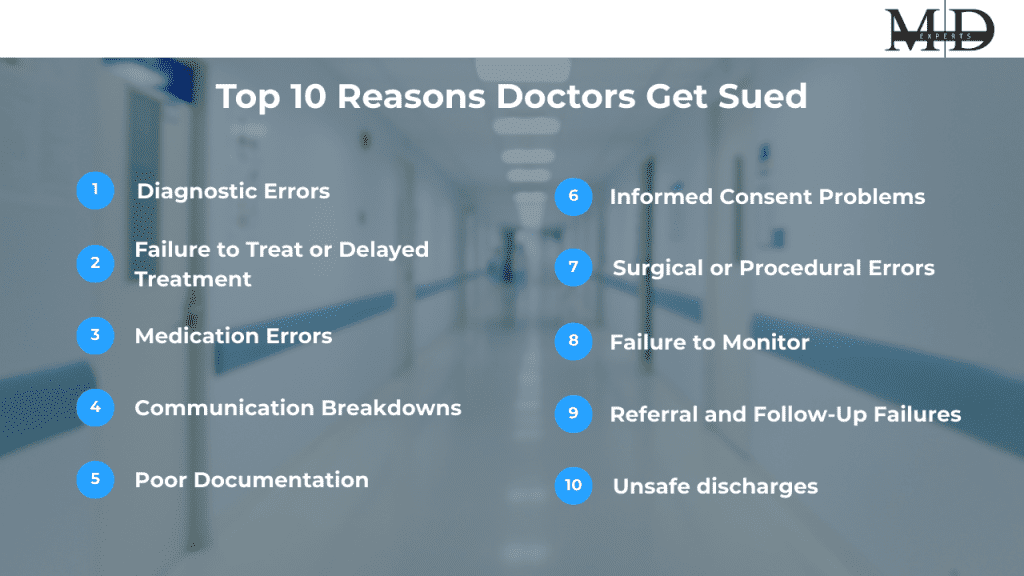
Below are the top 10 reasons doctors get sued—and how system-level problems contribute to each claim.
1. Diagnostic Errors
Diagnostic errors occur when a condition is missed, delayed, or incorrectly identified. These cases often revolve around whether a reasonable clinician would have recognized the warning signs sooner.
Why This Leads to Lawsuits: Patients feel harmed when a delay in diagnosis causes a condition to worsen — cancer spreading, stroke complications increasing, or infections progressing to sepsis.
How Systems Contribute:
• Abnormal results not flagged in the EHR
• Tests ordered but not followed up
• Understaffed clinics leading to rushed assessments
• Specialists unavailable or delayed
• Overdependence on templated notes instead of individualized assessments
Role of Medical Experts: Specialists such as Internal Medicine Expert Witnesses and Emergency Medicine Expert Witnesses analyze whether the diagnostic process aligned with accepted standards.
2. Failure to Treat or Delayed Treatment
Even when the diagnosis is correct, treatment delays can cause significant harm — from delayed antibiotics to late surgical intervention.
Why This Leads to Lawsuits: When outcomes worsen because treatment didn’t start quickly enough, patients assume the care team acted too slowly.
How Systems Contribute:
• Overwhelmed ERs
• Slow triage
• Delayed consultations
• Lack of clear escalation protocols
Role of Experts: Emergency Medicine Expert Witnesses review whether treatment timelines were reasonable given the clinical context.
3. Medication Errors
Medication claims range from wrong dosages to incorrect prescriptions to harmful drug interactions.
Why This Leads to Lawsuits: Patients expect medication safety to be one of the most basic parts of clinical care. When errors occur, harm is perceived as preventable.
How Systems Contribute:
• Miscommunication between nurses, physicians, and pharmacists
• Outdated medication lists
• Duplicate prescriptions
• Overridden safety alerts ("alert fatigue")
Role of Experts: Nurse Expert Witnesses and Medical Negligence Expert Witnesses review medication workflows and reconciliation processes.
4. Communication Breakdowns
Poor communication is one of the most common contributors to preventable harm.
Why This Leads to Lawsuits: Families frequently say, “No one told us,” or “We didn’t understand the plan,” which creates mistrust and increases litigation risk.
How Systems Contribute:
• Missing or incomplete handoffs
• Failure to communicate test results
• Conflicting instructions from multiple clinicians
• Language barriers without interpreters
Role of Experts: Medical Malpractice Expert Witnesses evaluate what communication should have occurred and whether documentation supports it.
5. Poor Documentation
Documentation doesn’t just record care — in litigation, it often is the evidence of care.
Why This Leads to Lawsuits: If something isn’t documented, attorneys argue it wasn’t done.
How Systems Contribute:
• Templated notes masking missing details
• Lack of timestamps or vital sign trends
• Rushed charting at the end of shifts
• Incomplete consent discussions
Role of Experts: Medical Expert Witnesses review the record to determine whether documentation meets professional standards.
6. Informed Consent Problems
Lawsuits arise when patients feel they weren’t adequately informed about risks, benefits, or alternatives.
Why This Leads to Lawsuits: Patients equate lack of clarity with lack of respect, leading to frustration and mistrust after adverse outcomes.
How Systems Contribute:
• Generic consent forms
• Lack of risk-specific documentation
• Time pressure before procedures
• Missing evidence of shared decision-making
Role of Experts: OB GYN Expert Witnesses and other specialists evaluate whether consent conversations were appropriate and properly documented.
7. Surgical or Procedural Errors
These cases involve harm during or immediately after a procedure.
Why This Leads to Lawsuits: Patients expect surgical teams to be highly coordinated. Any technical error is viewed as preventable.
How Systems Contribute:
• Lapses during time-out procedures
• Wrong-site or wrong-patient protocols
• Fatigue during long or overnight surgeries
• Breakdown in communication between OR team members
Role of Experts: Surgical subspecialty experts review whether operative technique and teamwork met professional standards.
8. Failure to Monitor
Patient deterioration cases often center on whether changes in condition were recognized and escalated appropriately.
Why This Leads to Lawsuits: If a preventable cardiac arrest, respiratory failure, or sepsis occurs, patients assume signs were missed.
How Systems Contribute:
• Alarm fatigue
• Missed vital sign trends
• Overburdened nursing staff
• Delayed physician notification
Role of Experts: Medical Experts and Nurse Expert Witnesses review monitoring frequency, escalation timing, and response actions.
9. Referral and Follow-Up Failures
Often seen in primary care, this involves failing to ensure patients complete tests, referrals, or follow-up visits.
Why This Leads to Lawsuits: Patients assume their doctor is tracking results — and are shocked to learn no one followed up.
How Systems Contribute:
• Lost referrals
• Abnormal tests not reviewed
• Lack of closed-loop communication
• Overreliance on patients to follow instructions
Role of Experts: Internal Medicine Expert Witnesses analyze whether follow-up expectations were clear and documented.
10. Unsafe Discharges
Discharge-related claims often focus on premature or poorly coordinated discharge decisions.
Why This Leads to Lawsuits: When patients return to the hospital or suffer complications soon after discharge, they believe they were “sent home too soon.”
How Systems Contribute:
• Rushed discharges
• Missing return precautions
• Poor communication with primary care
• Failure to consider home safety or support
Role of Experts: Medical Malpractice Expert Witnesses and Emergency Room Expert Witnesses review discharge planning and instructions.
Need a Qualified Medical Expert Witness? MD Experts Can Help.
Whether you need an OB GYN Expert Witness, Emergency Medicine Expert Witness, Nurse Practitioner Expert Witness, or any medical specialty, our network of MD Experts ensures you get the right expert for your case.
👉 Contact MD Experts today to speak with our team and find the right Medical Expert Witness for your case.