

Medical records are the backbone of healthcare delivery and legal accountability. In medical malpractice litigation, documentation serves as a primary source of evidence that reflects the care provided, clinical reasoning, and patient outcomes. When documentation is incomplete or inconsistent, it can significantly influence liability, case outcomes, and financial exposure for healthcare providers.
Incomplete or inaccurate records not only compromise patient care but also create serious legal risks. In malpractice cases, courts, attorneys, and expert witnesses rely heavily on clinical records to determine whether a provider met the accepted standard of care. Without proper documentation, defending or proving a claim becomes far more difficult.
This blog explores how incomplete medical documentation malpractice issues, documentation gaps liability, and charting documentation legal risk impact medical malpractice litigation—and why accurate records remain essential in building reliable malpractice evidence documentation.
Why Medical Documentation Matters in Malpractice Cases
Medical records are more than administrative paperwork—they are legal documents that provide a detailed history of patient care. These records include physician notes, nursing documentation, diagnostic reports, treatment plans, medication administration records, and consent forms.
In malpractice litigation, these documents serve several important purposes:
• Establish the timeline of medical events
• Demonstrate clinical decision-making
• Confirm adherence to the standard of care
• Provide factual evidence for expert witnesses
Courts often treat medical records as business records that can be admitted as evidence during litigation. However, the reliability and credibility of these records depend heavily on their completeness and accuracy.
When documentation is thorough and consistent, it strengthens a provider’s defense. Conversely, incomplete medical documentation malpractice claims often arise when key information is missing or poorly recorded.
The Legal Risks of Documentation Gaps
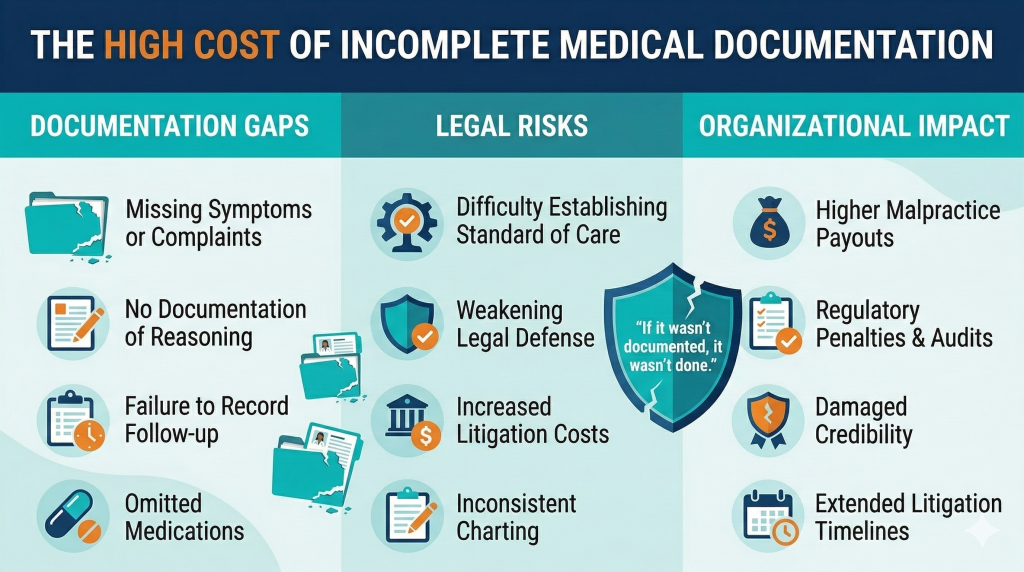
One of the most common problems in malpractice litigation is documentation gaps liability. Missing entries, unclear notes, or incomplete charting can create uncertainty about what actually occurred during patient care.
In legal proceedings, such gaps may lead to several complications:
1. Difficulty Establishing the Standard of Care
Medical malpractice claims typically require proving that a provider deviated from the accepted standard of care. Without clear documentation, it becomes challenging to determine what clinical decisions were made and why.
2. Weakening the Provider’s Legal Defense
If a physician cannot demonstrate through records that proper care was delivered, courts may interpret missing documentation as evidence that the care did not occur. A common legal principle in healthcare litigation is: “If it wasn’t documented, it wasn’t done.”
3. Increased Litigation Costs
Cases involving incomplete records often require additional expert testimony, forensic record analysis, and extended investigation, which can increase the time and cost of litigation.
Charting Documentation Legal Risk in Clinical Practice
Healthcare providers face significant charting documentation legal risk when documentation standards are inconsistent or poorly maintained.
Common charting errors that contribute to malpractice exposure include:
• Missing patient symptoms or complaints
• Lack of documentation for clinical reasoning
• Failure to record follow-up instructions or referrals
• Omitted medication administration records
• Incomplete informed consent documentation
• Delayed or altered entries after adverse events
Such omissions can create doubts about whether appropriate care was delivered. Courts may interpret these omissions as negligence, particularly if they involve critical clinical decisions or treatment steps.
Moreover, inconsistent documentation can undermine the credibility of healthcare providers during litigation. If records appear contradictory or incomplete, expert witnesses and juries may question the reliability of the provider’s testimony.
Malpractice Evidence Documentation: Why Accuracy Is Critical
In medical malpractice litigation, malpractice evidence documentation plays a pivotal role in establishing the facts of a case.
Accurate records enable legal teams to reconstruct patient care events and determine:
• When symptoms first appeared
• What diagnostic tests were ordered
• How clinicians interpreted the results
• Whether treatment decisions were appropriate
• Whether follow-up care occurred
Incomplete documentation disrupts this process by leaving unanswered questions.
For example, if a patient’s chart does not show documentation of a critical lab result review, attorneys may argue that the provider failed to evaluate the result—potentially supporting allegations of negligence.
Incomplete records also complicate expert analysis. Medical experts depend on detailed documentation to assess whether care met professional standards. When records are missing or inconsistent, experts must rely on assumptions rather than objective evidence.
Financial and Operational Consequences
The consequences of incomplete medical documentation malpractice issues extend beyond legal liability.
Healthcare organizations may face:
• Higher malpractice claim payouts
• Increased insurance premiums
• Extended litigation timelines
• Regulatory penalties for record-keeping violations
Research suggests that inadequate documentation significantly increases the likelihood of indemnity payments and prolongs malpractice litigation.
Additionally, regulatory bodies require healthcare providers to maintain accurate patient records. Failure to comply with documentation standards can lead to audits, sanctions, or professional disciplinary actions.
Preventing Documentation Gaps in Healthcare
Reducing documentation gaps liability requires consistent documentation practices and effective training within healthcare organizations.
Key strategies include:
Standardized Documentation Protocols
Healthcare systems should implement standardized charting guidelines to ensure consistency across providers and departments.
Continuous Training
Clinicians and staff should receive ongoing education on medical record documentation and legal compliance.
Electronic Health Record Optimization
Properly configured electronic health records (EHRs) can improve accuracy by reducing manual errors and ensuring required fields are completed.
Timely Documentation
Notes should be entered promptly after patient encounters to ensure accuracy and prevent retrospective entries that may raise legal concerns.
The Role of Medical Record Experts in Malpractice Cases
Because medical documentation plays such a critical role in malpractice litigation, attorneys often rely on medical experts to analyze records and identify inconsistencies.
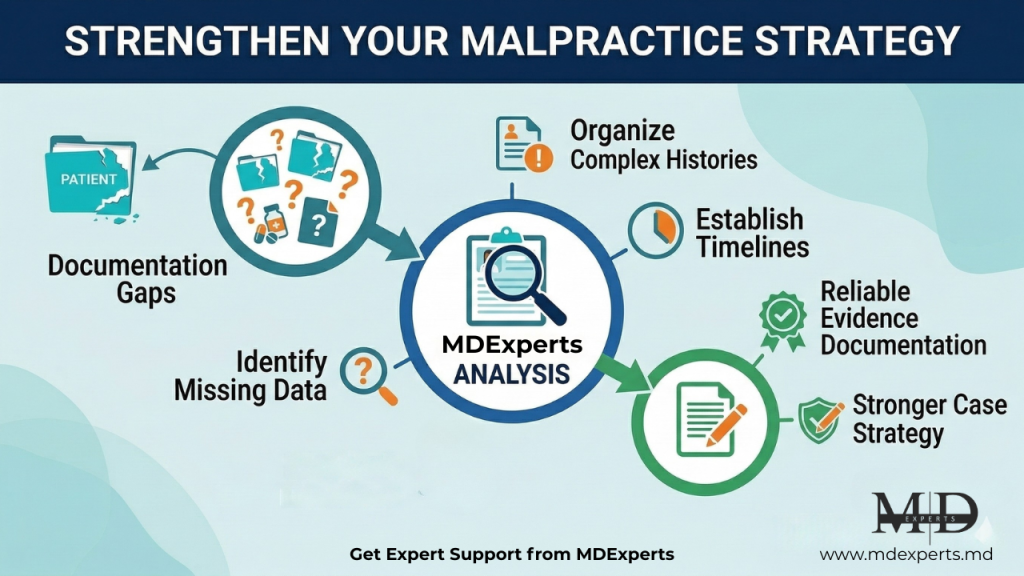
Medical record review specialists can help:
• Identify documentation gaps
• Organize complex medical histories
• Establish treatment timelines
• Support expert witness testimony
• Strengthen case strategy
This is where specialized medical-legal expertise becomes essential.
At MDExperts, our team provides comprehensive medical record analysis and expert support for malpractice litigation. Our experts assist attorneys in reviewing clinical records, identifying critical documentation issues, and developing clear, evidence-based case strategies.
Learn more or get expert support through our contact page.
Conclusion
Medical documentation is one of the most influential factors in medical malpractice litigation. Incomplete or inconsistent records can create significant legal exposure for healthcare providers and complicate the process of establishing liability.
From charting documentation legal risk to documentation gaps liability, missing or inaccurate records can weaken defenses, prolong litigation, and increase financial consequences.
Conversely, thorough and accurate malpractice evidence documentation strengthens both patient safety and legal accountability. By prioritizing proper record-keeping practices and leveraging expert analysis when disputes arise, healthcare providers and legal teams can better navigate the complex landscape of medical malpractice cases.
References
1. National Center for Biotechnology Information (NCBI) – Medical records and issues in negligence
Accessed March 09, 2026
2. PLUS (Professional Liability Underwriting Society) – The Hidden Liability in Your EMR
Accessed March 09, 2026