
A medical test is only as useful as the system that ensures its results are reviewed, communicated, and acted upon. When an abnormal laboratory result, pathology report, imaging study, or referral is overlooked, misplaced, or never communicated to the patient, the consequences can extend far beyond an administrative mistake.
A missed follow-up can delay diagnosis, postpone treatment, worsen a patient's prognosis, and potentially become the basis for a medical malpractice claim.
For attorneys evaluating a potential case, understanding how a missed test result occurred—and whether the resulting delay caused patient harm—is often critical.
What Happens When Test Results Fall Through the Cracks?
Healthcare delivery involves multiple people and systems: ordering clinicians, laboratories, radiologists, specialists, nurses, administrative staff, electronic health records, and patients. Every handoff creates an opportunity for information to be delayed or lost.
The Agency for Healthcare Research and Quality (AHRQ) identifies testing as a significant area of diagnostic risk. Research summarized by AHRQ indicates that between 6.8% and 62% of abnormal laboratory results and 1.0% to 35.7% of abnormal imaging results may not receive appropriate follow-up.
The problem can occur at several points:
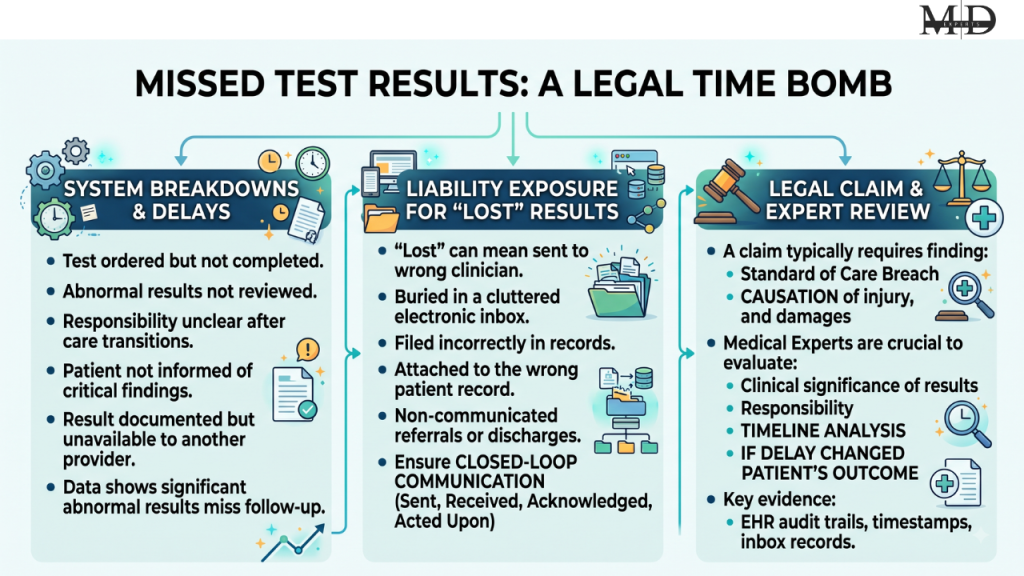
- A test is ordered but never completed.
- A completed test is not received by the ordering clinician.
- An abnormal result is received but not reviewed.
- The result is reviewed but no follow-up action is taken.
- The patient is not informed of the result.
- A referral is made but never completed.
- Responsibility for follow-up is unclear after a transition of care.
- A result is documented in one system but unavailable to another provider.
These breakdowns can create what is commonly described as a failure to "close the loop."
What Is a Missed Follow-Up Malpractice Claim?
A missed follow-up malpractice claim may arise when a healthcare provider fails to appropriately follow up on a test, finding, referral, or clinical concern and that failure contributes to patient harm.
Not every missed follow-up constitutes malpractice. A legal claim generally requires a fact-specific analysis of issues such as the applicable standard of care, whether the provider breached that standard, whether the breach caused an injury, and the damages involved. Requirements vary by jurisdiction.
The medical question is often more complicated than simply asking, "Was the result missed?"
An expert may need to determine:
- Was follow-up clinically indicated?
- Who was responsible for reviewing and acting on the result?
- Was the result available to that person?
- Was the result appropriately interpreted?
- Was the patient notified?
- Was additional testing, referral, or treatment required?
- How long was the delay?
- Did the delay change the patient's clinical outcome?
Lost Test Results Can Create Significant Liability Exposure
Lost test results liability is not limited to a physical document disappearing from a chart.
A "lost" result may effectively disappear because it was:
- Sent to the wrong clinician or department
- Buried in an electronic inbox
- Filed incorrectly
- Not transferred during a change in providers
- Never acknowledged
- Attached to the wrong patient record
- Available in one electronic system but not another
- Not communicated after a referral or hospital discharge
The Joint Commission specifically identifies lost test results and communication or care-coordination breakdowns as factors that can contribute to diagnostic errors. It describes closed-loop communication as a process in which test results are sent, received, acknowledged, and acted upon.
This distinction matters because the existence of an electronic health record does not automatically mean that the appropriate clinician actually saw, understood, and acted on a result.
Follow-Up Errors in Medical Malpractice Cases
Follow-up errors in medical malpractice cases can involve both individual decisions and broader system failures.
For example, consider a patient whose imaging study identifies a suspicious abnormality. The report is transmitted electronically, but the ordering provider does not review it. Months later, the patient returns with worsening symptoms and is diagnosed with an advanced disease.
The key issue is not simply that the diagnosis was delayed. A medical expert may need to reconstruct the entire chain of events:
Test ordered → Test performed → Result generated → Result transmitted → Result received → Result reviewed → Patient notified → Follow-up arranged → Treatment initiated
A failure at any point may contribute to the ultimate outcome.
The Joint Commission has emphasized that timely follow-up of laboratory and radiology results is essential and that communication failures can contribute to delayed diagnosis.
Diagnostic Follow-Up Negligence: When Does a Delay Matter?
Diagnostic follow-up negligence becomes particularly important when a missed or delayed result could reasonably have changed the patient's care.
For example, an abnormal result might require:
- Repeat laboratory testing
- Additional imaging
- Specialist consultation
- Biopsy or pathology review
- Medication changes
- Surgical evaluation
- Additional monitoring
- Immediate emergency intervention
The medical expert's role is not simply to identify that a result was abnormal. The expert must evaluate what should have happened next and whether timely action would likely have affected the patient's outcome.
AHRQ notes that failures in test-result management and communication can contribute to missed or delayed diagnoses and emphasizes the importance of closing the loop on diagnostic information.
The Difference Between a Missed Result and a Missed Diagnosis
A missed test result does not automatically mean that a provider missed a diagnosis.
These are separate questions:
Was the result appropriately managed?
and
Would appropriate management have resulted in an earlier or more accurate diagnosis?
For litigation purposes, that distinction can be critical.
A medical expert may need to review the patient's clinical history, symptoms, test results, timelines, treatment decisions, subsequent diagnoses, and applicable clinical standards to determine whether the missed follow-up was medically significant.
What Evidence Can Reveal a Follow-Up Failure?
When evaluating a potential case, the medical record may contain more information than the final clinical notes suggest.
Relevant evidence can include:
- Laboratory and pathology reports
- Radiology reports and images
- Electronic health record timestamps
- Inbox and notification records
- Referral orders and completion records
- Patient portal messages
- Telephone documentation
- Discharge summaries
- Specialist correspondence
- Medication records
- Appointment histories
- Messages between providers and staff
- EHR audit trails
- Documentation showing when results were reviewed
AHRQ has identified communication failures, poor test-result management, transitions of care, and unclear follow-up responsibilities as recurring contributors to diagnostic safety problems.
In some cases, reviewing the chronology of the record can be just as important as reviewing the clinical content itself.
Why Medical Expert Review Matters
A missed follow-up case often requires an analysis that combines clinical knowledge with careful reconstruction of the timeline.
A qualified medical expert can help attorneys evaluate questions such as:
- What should the provider have done after receiving the result?
- Was the result clinically significant?
- Was the follow-up timely?
- Who was responsible for the next step?
- Did the documentation accurately reflect what occurred?
- Was the patient appropriately informed?
- Did the delay contribute to the patient's injury?
- Was the outcome potentially avoidable with timely intervention?
A systematic review published through AHRQ's PSNet found that failure to follow up on abnormal laboratory and radiology results is a recognized patient-safety problem and can contribute to missed or delayed diagnoses.
How MDExperts Can Help
At MDExperts, we connect attorneys with qualified medical experts who can evaluate the clinical issues underlying complex medical malpractice and negligence cases.
For cases involving missed test results, delayed diagnoses, communication breakdowns, or follow-up failures, an appropriately qualified expert can help assess the medical facts, reconstruct the sequence of care, and provide an objective medical opinion regarding the issues in dispute.
Whether a case involves primary care, emergency medicine, radiology, pathology, hospital care, nursing, or another specialty, the right medical expertise can help attorneys understand what happened medically—and why it matters.
Have a case involving a missed diagnosis, lost test result, or failure to follow up?
Contact MDExperts for a Case Review
References
1. Agency for Healthcare Research and Quality (AHRQ) - Diagnostic Safety and Quality – Results: Testing and Test Results Management
Accessed August 17, 2026
2. The Joint Commission - Standards Interpretation FAQs
Accessed August 17, 2026
3. AHRQ Patient Safety Network - Failure to Follow-Up Test Results for Ambulatory Patients
Accessed August 17, 2026
4. Agency for Healthcare Research and Quality - Electronic Test Result Communication in the Era of the 21st Century Cures Act
Accessed August 17, 2026