
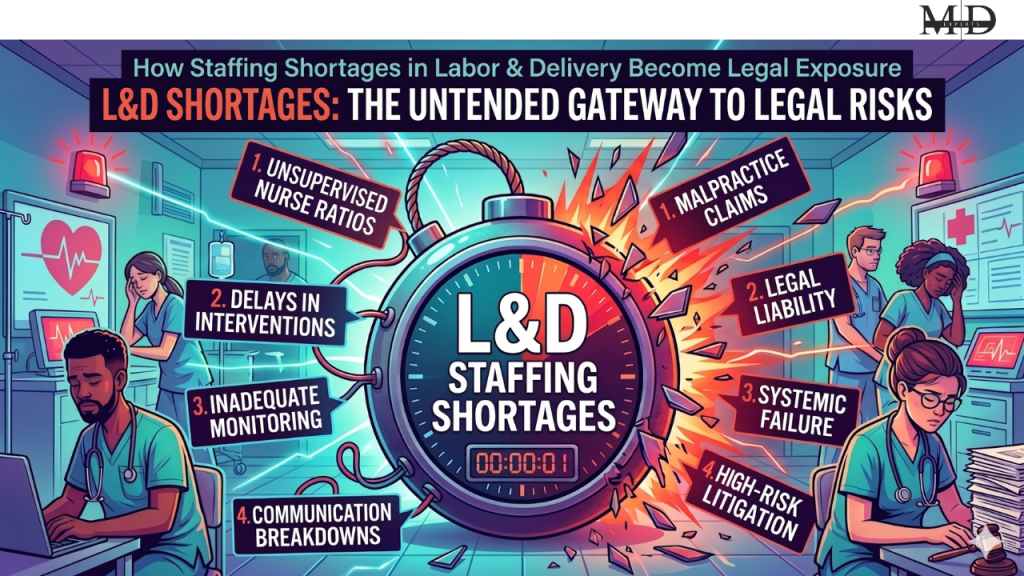
Labor and delivery units operate in one of the most time-sensitive, high-risk environments in healthcare. When staffing levels fall short, the consequences are not just clinical—they can quickly evolve into significant legal exposure. Increasingly, hospitals and providers are facing labor and delivery staffing malpractice claims tied directly to systemic workforce gaps rather than isolated clinical errors.
This blog explores how OB staffing shortages liability emerges, why these cases are rising, and what healthcare organizations can do to mitigate risk.
The High-Stakes Nature of Obstetric Care
Obstetrics has long been one of the most litigated specialties in medicine. Claims are often severe, involving lifelong injuries or death.
• Up to 80% of obstetric liability claims involve high-severity injuries, including neurological damage or death
• Adverse outcomes in labor and delivery frequently result in catastrophic, lifelong consequences, driving high-value litigation
Because outcomes are so sensitive to timing, communication, and coordination, even small breakdowns—often caused by understaffing—can lead to allegations of staffing related negligence obstetrics.
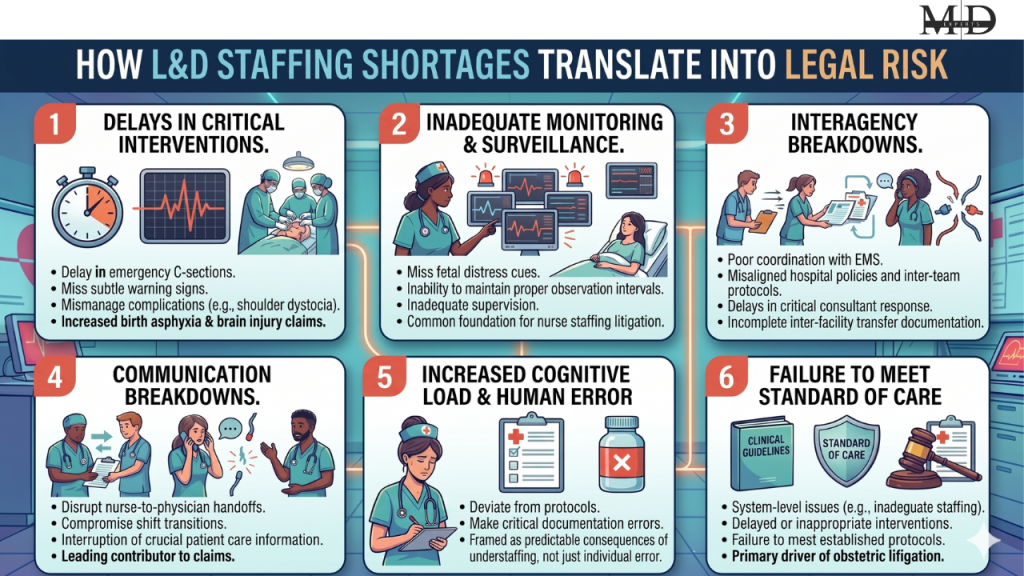
How Staffing Shortages Translate Into Legal Risk
1. Delays in Critical Interventions
In labor and delivery, minutes matter. Staffing shortages can delay:
• Emergency cesarean sections
• Response to fetal distress
• Escalation of complications like shoulder dystocia
Failure to act promptly is a leading driver of malpractice claims, particularly when linked to poor outcomes such as birth asphyxia or brain injury.
When delays can be traced to insufficient staffing, plaintiffs may argue OB staffing shortages liability due to systemic failure—not just individual error.
2. Inadequate Monitoring and Surveillance
Continuous fetal monitoring and maternal assessment are essential. However:
• Understaffed teams may miss subtle warning signs
• Overburdened nurses may be unable to maintain proper observation intervals
Research shows that inadequate monitoring and supervision are more likely in understaffed environments, increasing malpractice exposure.
This is a common foundation for nurse staffing OB litigation, where plaintiffs claim that proper staffing ratios would have prevented harm.
3. Communication Breakdowns
Effective communication is critical in obstetrics—but staffing gaps disrupt:
• Nurse-to-physician handoffs
• Shift transitions
• Escalation of patient concerns
Studies indicate that communication failures contribute to a significant portion of obstetric malpractice claims, including breakdowns both with patients and within care teams.
When staffing shortages force reliance on unfamiliar or temporary staff, these risks increase—creating a direct path to labor and delivery staffing malpractice claims.
4. Increased Cognitive Load and Human Error
Overworked clinicians are more likely to:
• Miss critical clinical cues
• Deviate from protocols
• Make documentation errors
Staffing shortages often lead to shortcuts in patient safety procedures and increased medical errors.
In litigation, these errors are rarely viewed in isolation. Instead, they are framed as predictable consequences of systemic understaffing—strengthening claims of staffing related negligence obstetrics.
5. Failure to Meet Standard of Care
At the core of every malpractice case is the question: Did the provider meet the standard of care?
System-level issues—such as inadequate staffing—can lead to:
• Non-adherence to clinical guidelines
• Delayed or inappropriate interventions
• Gaps in documentation or informed consent
Failure to meet established standards is one of the primary drivers of obstetric malpractice litigation.
Why Staffing Issues Are Increasingly Central in Litigation
Historically, malpractice cases focused on individual clinicians. Today, there is a shift toward examining systemic failures, including staffing models.
Several trends are driving this shift:
• Persistent workforce shortages post-pandemic
• Greater transparency into hospital operations
• Availability of staffing records and internal reports in discovery
• Growing recognition of institutional accountability
This evolution means healthcare organizations—not just clinicians—are increasingly named in lawsuits tied to nurse staffing OB litigation and broader operational failures.
Risk Mitigation Strategies for Healthcare Organizations
To reduce exposure to labor and delivery staffing malpractice, organizations should focus on proactive risk management:
Strengthen Staffing Models
• Implement acuity-based staffing rather than fixed ratios
• Maintain surge capacity for high-volume periods
Improve Communication Systems
• Standardize handoff protocols
• Use structured communication tools (e.g., SBAR)
Enhance Documentation
• Clearly document staffing constraints and escalation attempts
• Ensure real-time recording of clinical decisions
Invest in Training and Simulation
• Prepare teams for obstetric emergencies
• Reinforce rapid-response protocols
Leverage Expert Review
Independent clinical reviews can help identify vulnerabilities before they result in litigation.
The Role of MDExperts
At MDExperts, we analyze complex obstetric cases, including those involving OB staffing shortages liability and staffing related negligence obstetrics. Our OB-GYN specialists are uniquely positioned to evaluate whether adverse outcomes stemmed from clinical decision-making, system failures, or true OB staffing shortages liability.
Our physician experts provide:
• Objective case reviews
• Standard-of-care analysis
• Expert witness testimony
Protect your organization and strengthen your case strategy. Visit our contact page to connect with our experts today.
Conclusion
Staffing shortages in labor and delivery are no longer just an operational challenge—they are a growing legal risk. As litigation increasingly focuses on systemic issues, healthcare organizations must recognize that inadequate staffing can directly translate into nurse staffing OB litigation and labor and delivery staffing malpractice claims.
Addressing these risks requires more than short-term fixes. It demands a strategic, system-wide approach to staffing, communication, and patient safety.
References
1. National Library of Medicine - Evaluative reports on malpractice policies in obstetrics
Accessed April 20, 2026
2. The Future of World Work - How staffing shortages increase malpractice risks
Accessed April 20, 2026
3. Harvard Medical Foundation - Risks in Obstetrical Care: Contributing Factors
Accessed April 20, 2026
4. Fierce Healthcare - Report on severity of obstetric liability claims
Accessed April 20, 2026
5. Medical Professional Liability Association - Intersection of staffing and medical liability
Accessed April 20, 2026