
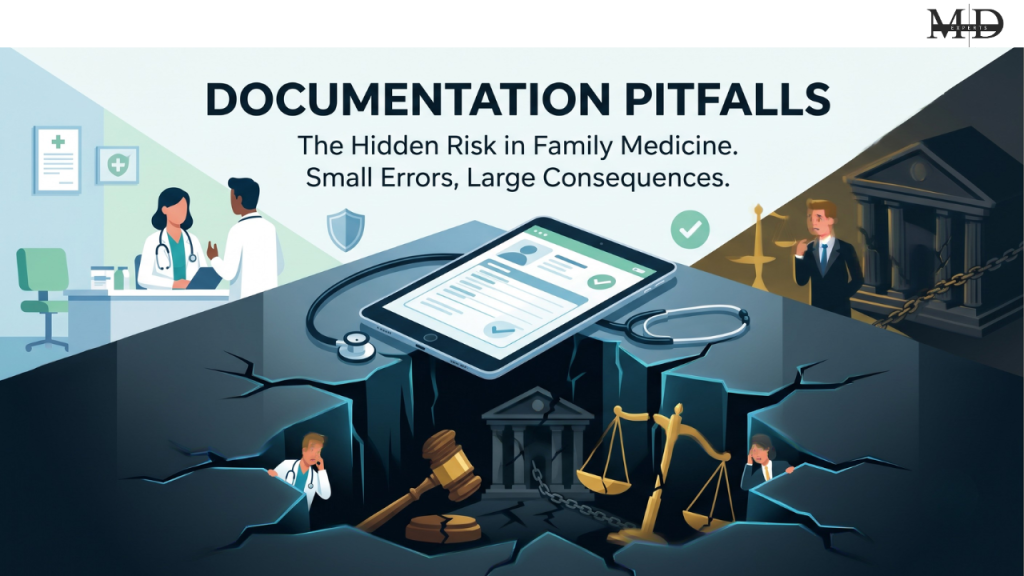
In family medicine, documentation is more than a clinical record—it’s the foundation of quality patient care, continuity, reimbursement, and legal protection. While physicians focus on diagnosing and treating patients, medical records often become the primary evidence reviewed during malpractice claims, insurance audits, and regulatory investigations.
Unfortunately, many documentation pitfalls in family medicine are avoidable. Even highly competent physicians can face legal scrutiny when patient records are incomplete, inconsistent, or unclear. In many malpractice cases, the quality of the documentation—not necessarily the quality of care—plays a significant role in determining the outcome.
This article explores the most common documentation mistakes that increase legal exposure and explains how family physicians can strengthen their medical records to reduce risk.
Why Documentation Matters in Family Medicine
Family physicians manage diverse patient populations and often provide long-term, continuous care. Because of this, patient charts frequently become lengthy and complex, documenting preventive care, chronic disease management, acute illnesses, referrals, medications, and follow-up visits.
When documentation is incomplete, it becomes difficult to demonstrate:
- Clinical reasoning behind decisions
- Patient discussions and informed consent
- Follow-up recommendations
- Compliance with clinical guidelines
- Continuity of care among multiple providers
From a legal standpoint, if something is not documented, it is often difficult to prove that it occurred.
Common Documentation Pitfalls in Family Medicine
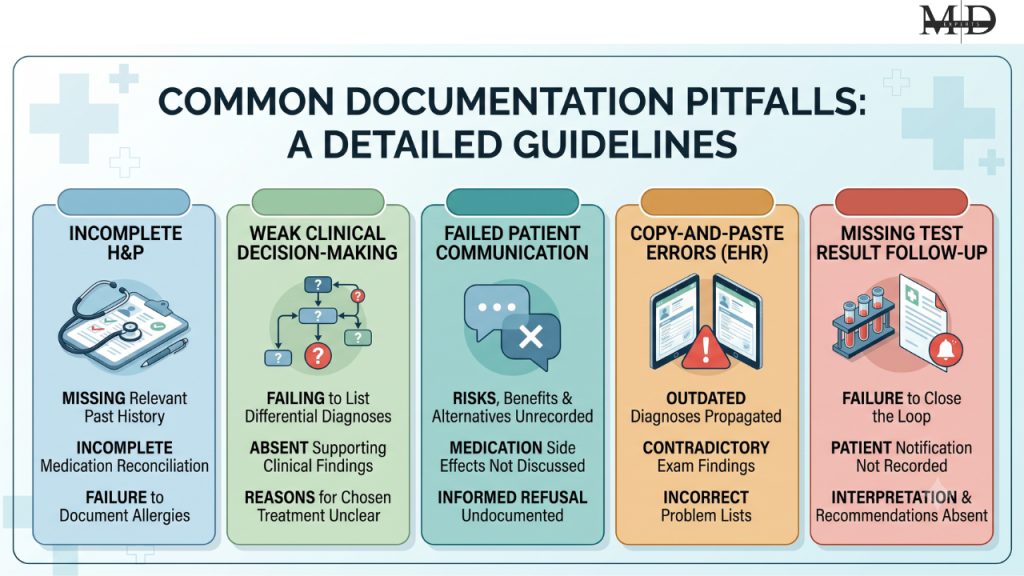
1. Incomplete History and Physical Examination
One of the most common documentation pitfalls in family medicine is failing to capture a complete patient history or physical examination.
Examples include:
- Missing relevant past medical history
- Incomplete medication reconciliation
- Failure to document allergies
- Limited review of systems
- Inadequate physical examination findings
These omissions can make it difficult to justify diagnostic decisions if questions arise later.
2. Poor Documentation of Clinical Decision-Making
Medical records should explain why a particular diagnosis or treatment plan was chosen—not simply list the diagnosis.
Documentation should include:
- Differential diagnoses considered
- Supporting clinical findings
- Relevant laboratory or imaging results
- Reasons for choosing or avoiding certain treatments
Clear documentation of clinical reasoning is one of the strongest defenses against primary care documentation malpractice claims.
3. Failure to Document Patient Communication
Many legal disputes arise not because the wrong treatment was provided, but because conversations with patients were never documented.
Important discussions include:
- Risks and benefits of treatment
- Alternative treatment options
- Medication side effects
- Lifestyle recommendations
- Return precautions
- Shared decision-making
- Informed refusal when patients decline recommendations
Well-documented communication demonstrates that patients were appropriately informed before decisions were made.
4. Copy-and-Paste Errors
Electronic Health Records (EHRs) have improved efficiency but introduced new risks.
Copying forward previous notes without verification may result in:
- Outdated diagnoses
- Incorrect medication lists
- Contradictory examination findings
- Inaccurate problem lists
These charting errors legal risk issues can undermine the credibility of the entire medical record during litigation or audits.
Every copied section should be reviewed and updated to reflect the patient's current condition.
5. Missing Follow-Up Documentation
Family medicine often involves ongoing management rather than one-time treatment.
Documentation should clearly record:
- Follow-up recommendations
- Referral instructions
- Pending test results
- Patient compliance discussions
- Missed appointments
- Outreach attempts
Without these details, physicians may struggle to demonstrate appropriate continuity of care.
6. Incomplete Records in Primary Care
One of the most frequently cited concerns during audits and legal reviews is incomplete records primary care practices.
Common examples include:
- Missing diagnostic test results
- Unrecorded specialist referrals
- Lack of vaccination documentation
- Missing medication changes
- Incomplete chronic disease monitoring
- Absent care coordination notes
Incomplete records can create the impression that appropriate care was not delivered—even when it was.
7. Altering Records After the Fact
Late entries are sometimes necessary, but they should always be properly identified with the actual date and time they were added.
Editing records without disclosure may raise questions about record integrity and credibility.
If additional information must be documented after a visit, it should be entered as a clearly labeled late entry rather than modifying the original documentation.
8. Vague or Generic Notes
Documentation should accurately reflect the patient's unique clinical situation.
Generic statements such as:
- "Patient doing well"
- "Continue medications"
- "Follow up as needed"
provide little evidence of clinical assessment or decision-making.
Instead, notes should include:
- Current symptoms
- Objective findings
- Assessment
- Treatment rationale
- Follow-up plan
Specific documentation supports both patient care and legal defensibility.
9. Medication Documentation Errors
Medication-related documentation remains a significant contributor to patient safety events.
Family physicians should consistently document:
- Medication reconciliation
- New prescriptions
- Dose adjustments
- Patient counseling
- Adverse reactions
- Discontinued medications
Accurate medication records reduce the likelihood of adverse events and strengthen legal documentation.
10. Failure to Document Test Result Follow-Up
Ordering a diagnostic test is only one part of patient care.
Medical records should document:
- Test review
- Patient notification
- Interpretation of results
- Additional recommendations
- Follow-up actions
Failure to close the loop on abnormal test results is a recurring issue in primary care documentation malpractice cases.
Best Practices to Reduce Documentation Risk
Family physicians can strengthen documentation by adopting several practical habits:
- Complete notes as soon as possible after patient encounters.
- Document clinical reasoning rather than simply listing diagnoses.
- Record informed consent and shared decision-making discussions.
- Review copied information before signing notes.
- Maintain accurate medication and allergy lists.
- Clearly document referrals and follow-up plans.
- Use standardized documentation templates while ensuring they are individualized for each patient.
- Perform periodic documentation audits to identify opportunities for improvement.
Consistent documentation practices not only improve patient safety but also reduce legal and regulatory risk.
How MDExperts Supports Better Clinical Documentation
Strong clinical documentation is essential for delivering high-quality patient care while minimizing legal exposure. At MDExperts, we work with healthcare organizations and physicians to improve documentation quality through expert medical reviews, clinical documentation support, and evidence-based guidance.
Whether you're looking to strengthen documentation processes, prepare for quality reviews, improve record accuracy, or engage a Family Medicine expert witness for litigation support or case review, our team can help.
Contact MDExperts today to learn how our expertise can support your organization in improving documentation quality and reducing medico-legal risk.
Final Thoughts
The most common documentation pitfalls in family medicine are often preventable. Clear, accurate, and timely documentation helps support clinical decision-making, facilitates continuity of care, and provides critical evidence if documentation is ever reviewed during audits or legal proceedings.
By avoiding common charting errors legal risk, addressing incomplete records primary care, and improving documentation practices overall, family physicians can better protect both their patients and their practice.
References
1. American Academy of Family Physicians (AAFP) – Documentation Resources
Accessed July 06, 2026
2. American Medical Association (AMA) – CPT Evaluation and Management Documentation
Accessed July 06, 2026
3. Office of Inspector General (U.S. Department of Health and Human Services) - Compliance Guidance for Individual and Small Group Physician Practices.
Accessed July 06, 2026