
Diagnostic errors are among the most consequential patient-safety problems in healthcare. In primary care, where clinicians often evaluate undifferentiated symptoms, manage chronic conditions, order diagnostic testing, and coordinate referrals, the diagnostic process can involve numerous opportunities for information to be missed, delayed, or misinterpreted.
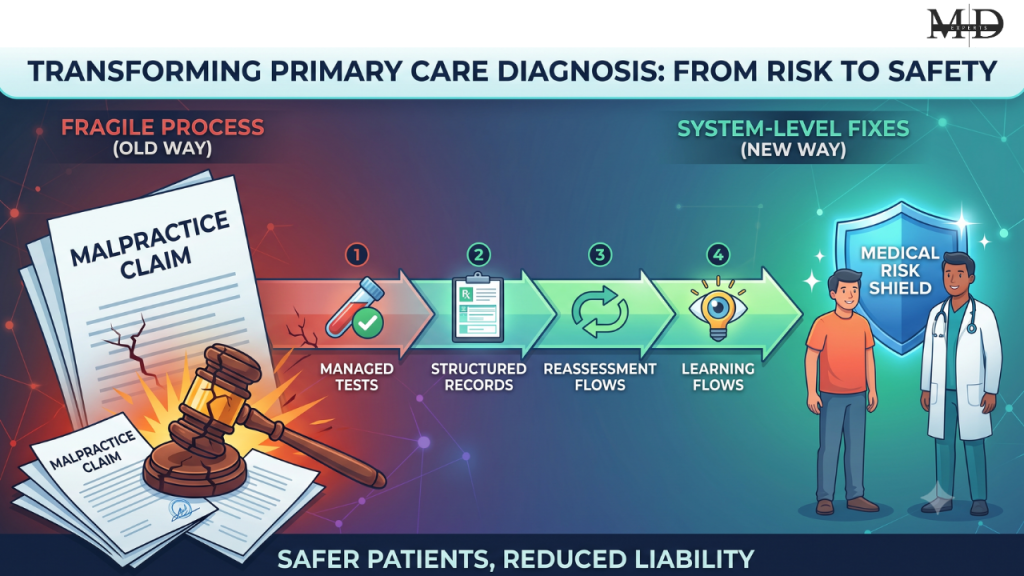
For healthcare organizations, improving this process is not simply a quality-improvement initiative. Effective system level diagnostic fixes can also help reduce preventable patient harm and potentially decrease the circumstances that contribute to medical malpractice claims.
For legal professionals evaluating a potential diagnostic error primary care case, understanding how the underlying clinical system functioned can be just as important as reviewing the individual clinician's decision-making.
What Is Diagnostic Error in Primary Care?
Diagnostic error generally includes a diagnosis that is missed, delayed, or incorrect. The problem may occur at virtually any point in the diagnostic process—from collecting the patient's history to ordering tests, interpreting findings, communicating results, arranging referrals, or following up after an abnormal result.
Primary care is particularly vulnerable because diagnosis frequently occurs over multiple encounters rather than during a single clinical episode.
A patient may initially present with nonspecific symptoms. Laboratory testing may be ordered. A referral may be placed. Results may return after the patient's appointment. Another clinician may subsequently become involved.
Each transition creates another opportunity for information to be lost.
The Agency for Healthcare Research and Quality (AHRQ) identifies communication breakdowns, diagnostic and treatment problems, and fragmentation of care among important patient-safety concerns in primary care. AHRQ also notes that many diagnostic errors are associated with breakdowns in the processes surrounding the clinical encounter.
Why Diagnostic Errors Can Become Malpractice Claims
Not every diagnostic error constitutes malpractice. A poor outcome alone does not establish that a clinician breached the applicable standard of care.
However, when a missed or delayed diagnosis results from a preventable breakdown in the diagnostic process, questions may arise regarding whether appropriate care was provided.
A primary care diagnostic malpractice case may involve issues such as:
- Failure to recognize significant symptoms or risk factors
- Failure to order an appropriate diagnostic test
- Failure to review or act on abnormal results
- Failure to communicate clinically significant findings
- Failure to follow up after a referral
- Failure to appropriately document clinical reasoning
- Failure to reassess a patient when symptoms persist or change
- Inadequate communication between primary care, specialists, laboratories, or hospitals
- Failure to establish responsibility for monitoring outstanding tests or referrals
The National Academies has identified inadequate communication and poorly designed healthcare work systems among contributors to diagnostic error. It has also emphasized that improving diagnosis requires healthcare organizations to identify errors and near misses, learn from them, and redesign processes accordingly.
The Diagnostic Process Is a System, Not a Single Decision
One of the most important considerations when evaluating diagnostic error is that diagnosis rarely depends on one clinician making one decision.
Instead, it is a series of interconnected steps:
Patient presentation → history and examination → differential diagnosis → testing → results → interpretation → communication → follow-up → reassessment
A breakdown anywhere in this chain can affect the final outcome.
For example, a clinician may appropriately order a diagnostic test, but the result may not be reviewed promptly. Alternatively, the result may be reviewed but never communicated to the patient. A referral may be placed but never completed, with no system in place to alert the primary care team.
From a risk-management perspective, the question should therefore extend beyond:
“ What did the clinician do?”
It should also ask:
“ What system was in place to make sure the necessary diagnostic steps were completed?”
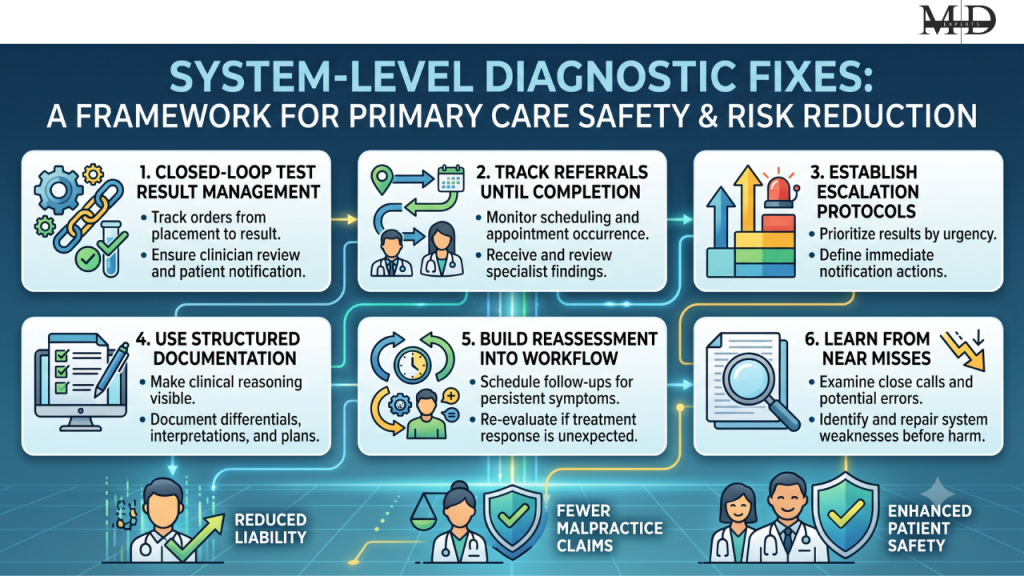
System-Level Diagnostic Fixes That Can Reduce Risk
1. Create Closed-Loop Test Result Management
One of the most important system level diagnostic fixes is establishing a reliable process for test-result management.
A closed-loop system should identify:
- Who ordered the test
- Who is responsible for reviewing the result
- How abnormal results are escalated
- How the patient is notified
- What follow-up is required
- How completion of follow-up is documented
AHRQ specifically identifies test ordering, result interpretation and management, and closing the loop on follow-up and communication as key components of diagnostic safety.
The AMA similarly emphasizes the importance of timely communication and clearly defined processes for communicating clinical test results.
2. Track Referrals Until Completion
A referral order is not the same as a completed referral.
Primary care practices can reduce diagnostic gaps by tracking whether:
- The referral was placed.
- The patient received scheduling information.
- The appointment occurred.
- The specialist's findings were received.
- The primary care clinician reviewed the information.
- Any recommended follow-up occurred.
AHRQ's patient-safety resources describe failures in closing the diagnostic referral loop as a significant source of risk, including delays in diagnosis and treatment.
3. Establish Escalation Protocols for Abnormal Findings
Not every abnormal result requires the same response.
Practices can establish protocols that categorize results according to urgency and specify when staff should immediately notify a clinician or initiate additional action.
This reduces reliance on memory and helps ensure that critical findings do not become buried among routine electronic health record notifications.
4. Use Structured Documentation for Diagnostic Reasoning
Documentation should make the clinical reasoning process understandable.
Depending on the clinical situation, useful documentation may include:
- Relevant symptoms and duration
- Pertinent positive and negative findings
- Differential diagnoses considered
- Tests ordered and the reason for ordering them
- Interpretation of significant results
- Follow-up instructions
- Return precautions
- Referrals and expected follow-up
The goal is not simply to create longer medical records. It is to create a record that accurately reflects the clinical decision-making process.
5. Build Reassessment Into the Workflow
A diagnosis made during an initial visit may need to change when the patient's symptoms persist, worsen, or evolve.
Primary care practices can create workflows that encourage reassessment when:
- Symptoms do not improve as expected
- A patient returns repeatedly with the same complaint
- A treatment does not produce the expected response
- New symptoms develop
- Abnormal findings remain unexplained
Diagnostic safety is an ongoing process rather than a one-time decision.
6. Learn From Near Misses
A practice does not need to wait for a patient to experience serious harm before examining a diagnostic process.
Near misses can reveal weaknesses such as:
- An abnormal result that was almost overlooked
- A referral that was nearly lost
- A critical message routed to the wrong clinician
- A follow-up appointment that was never scheduled
Reviewing these events can identify system weaknesses before they contribute to patient harm or litigation.
AHRQ and the National Academies both emphasize organizational learning and process improvement as important components of diagnostic safety.
What Legal Teams Should Look for in a Diagnostic Error Case
For attorneys evaluating a potential primary care diagnostic malpractice matter, reviewing the broader diagnostic workflow can provide important context.
In addition to the clinical record, it may be useful to examine:
- Test-ordering workflows
- Result-routing procedures
- EHR inbox responsibilities
- Referral tracking systems
- Telephone and portal communications
- Follow-up protocols
- Documentation policies
- Staffing and delegation practices
- Communication between primary and specialty care
- EHR audit trails
- Evidence of prior similar process failures
This type of review can help distinguish an isolated clinical judgment from a recurring system-level problem.
Diagnostic Process Improvement and Litigation
Diagnostic process improvement litigation issues often involve more than determining whether a diagnosis was ultimately correct.
A meaningful analysis may require reconstructing the timeline and determining where the diagnostic process deviated from expected practice.
For example:
Was the test ordered?
↓
Was it processed correctly?
↓
Was the result received?
↓
Was it reviewed?
↓
Was the patient notified?
↓
Was appropriate follow-up initiated?
↓
Was the patient reassessed when necessary?
This timeline-based approach can help identify where a breakdown occurred and whether that breakdown had a meaningful relationship to the patient's outcome.
Moving From Individual Blame to System Improvement
Reducing diagnostic errors should not be viewed solely as a matter of individual clinician performance.
Healthcare organizations can make diagnosis safer by designing systems that support clinicians: reliable test-result workflows, referral tracking, clear responsibility assignments, effective communication, structured documentation, and mechanisms for learning from errors.
The National Academies concluded that improving diagnosis requires healthcare organizations to redesign the diagnostic process and develop systems capable of identifying errors and learning from them.
For legal teams, understanding these systems can provide a more complete picture of what happened in a potential malpractice case.
How MDExperts Can Help
At MDExperts, physician-led medical analysis can help legal teams evaluate complex clinical issues involving diagnostic error, medical malpractice, standards of care, and healthcare system failures.
Our team of hospitalist experts can assist with medical record review, clinical timeline analysis, standard-of-care assessment, and evaluation of system-level factors that may have contributed to an adverse outcome.
When a case involves questions surrounding missed or delayed diagnosis, reviewing the diagnostic process—not just the final outcome—can be critical to understanding the medical issues.
Contact MDExperts to discuss an initial case review or medical expert consultation.
References
- Agency for Healthcare Research and Quality (AHRQ) - Patient Safety in Primary Care Settings
Accessed September 15, 2026 - AHRQ - Diagnostic Safety Resources
Accessed September 15, 2026 - National Academies of Sciences, Engineering, and Medicine - Improving Diagnosis in Health Care
Accessed September 15, 2026 - American Medical Association - Reporting Clinical Test Results
Accessed September 15, 2026