
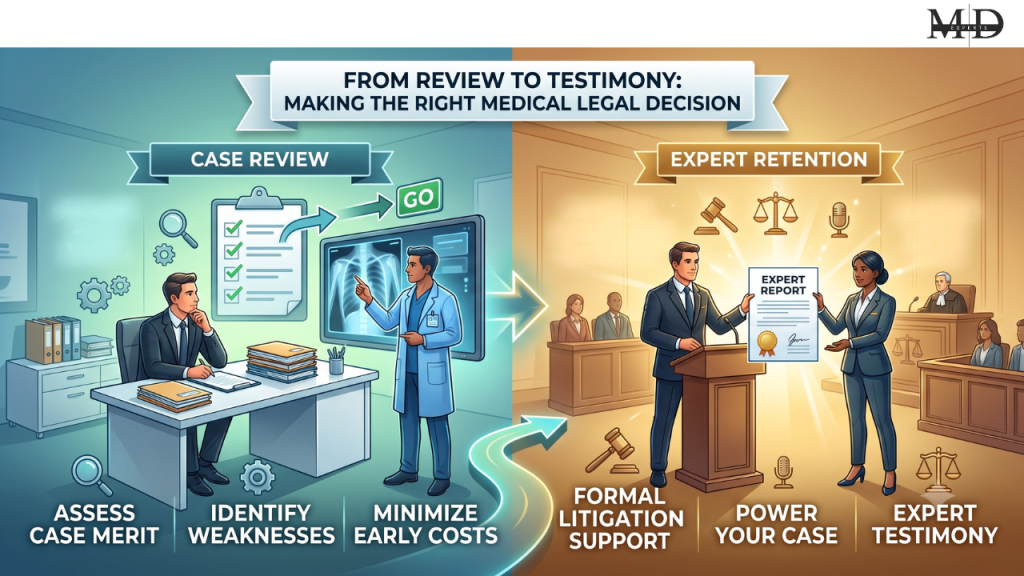
When handling a medical malpractice, personal injury, or other medically complex legal matter, attorneys often face an important question: Do I need a medical expert to review the case, or is it time to formally retain an expert?
Although these two steps are closely related, they serve different purposes in the legal case review process. Understanding the distinction between an initial case review and formal expert retention can help attorneys make informed decisions, manage litigation costs, and determine whether a case has sufficient medical support to move forward.
What Is a Medical Expert Case Review?
A medical expert case review is generally an early-stage evaluation of the medical facts and issues involved in a case.
During a review, a qualified medical professional may examine relevant medical records, imaging, treatment information, timelines, and other case materials to help determine whether the medical allegations are supported by the available evidence.
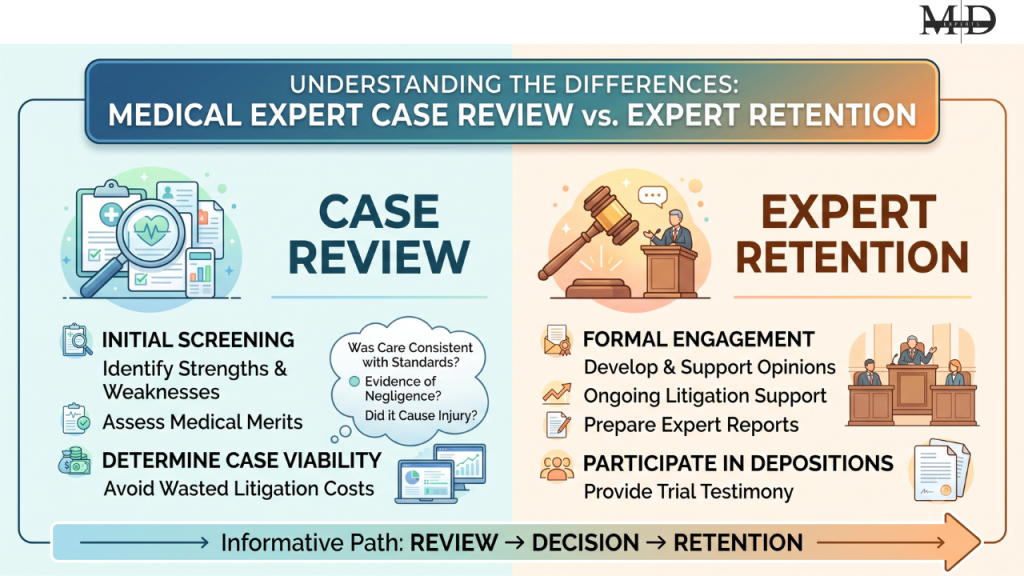
The goal is often to answer questions such as:
- Was the care consistent with the applicable standard of care?
- Was there a potential deviation from the expected standard?
- Is there evidence of medical negligence?
- Could the alleged negligence have caused or contributed to the patient's injury?
- Are the medical records consistent with the legal theory of the case?
- Are there significant weaknesses or gaps that should be addressed?
- Does the case appear to have sufficient medical merit to proceed?
This stage is commonly referred to as medical expert case screening or case evaluation.
A case review can be particularly valuable before an attorney commits to the expense and time associated with a formal expert engagement.
What Does It Mean to Retain a Medical Expert?
Retaining a medical expert is a more formal step in the litigation process.
Once an attorney determines that expert involvement is necessary, the expert may be retained to provide opinions and potentially participate in litigation-related activities such as:
- Preparing an expert report
- Reviewing additional records and evidence
- Evaluating the standard of care
- Addressing medical causation
- Reviewing opposing expert opinions
- Participating in depositions
- Assisting with mediation or settlement discussions
- Preparing for trial
- Providing deposition or trial testimony
In other words, retaining medical experts for litigation typically means establishing an ongoing professional relationship with the expert for specific litigation needs.
In federal litigation, expert disclosure requirements can apply when a party intends to use an expert to provide testimony. Federal Rule of Civil Procedure 26(a)(2), for example, addresses disclosure of expert witnesses and, in applicable circumstances, written expert reports.
Case Review vs. Expert Retention: The Key Difference
The simplest way to understand the distinction is:
| Case Review | Expert Retention |
|---|---|
| Usually an initial evaluation | Formal engagement |
| Focuses on medical merits and issues | Focuses on ongoing litigation support |
| Helps identify strengths and weaknesses | Supports development and presentation of expert opinions |
| Can help determine whether expert testimony is warranted | Expert may prepare reports and provide testimony |
| Often involves a defined set of records | May involve continuing review of records and evidence |
| Helps attorneys make early case decisions | Supports the case through later litigation stages |
The exact scope of either service can vary depending on the case, jurisdiction, expert, and engagement agreement.
Why Start With a Case Review?
One of the most important advantages of an initial review is that it can help attorneys make decisions before investing heavily in expert litigation services.
Medical cases can involve thousands of pages of records, multiple treating providers, complicated timelines, and competing explanations for an injury. An experienced medical reviewer can help identify the clinically important issues and determine whether the available evidence supports the legal theory.
For example, a case may initially appear to involve a clear failure to diagnose. A detailed medical review, however, may reveal that the relevant symptoms were nonspecific, the diagnostic information available at the time was limited, or the alleged delay did not medically cause the claimed injury.
Conversely, an early review may identify a significant standard-of-care concern that deserves further investigation.
This distinction makes case screening an important part of efficient litigation strategy.
When Should an Attorney Consider Retaining an Expert?
Formal retention may make sense when the case has progressed beyond preliminary evaluation and expert input is necessary to develop, support, or present the medical opinions required for litigation.
1. Expert testimony is required
Some medical claims cannot be effectively established without qualified expert testimony. The applicable requirements vary by jurisdiction and by the nature of the claim.
2. The medical issues are complex
Cases involving specialized procedures, causation questions, multiple conditions, or complicated treatment histories may require specialized medical expertise.
3. A report or formal opinion is needed
If the litigation requires a formal expert report or detailed written opinion, an attorney may need to move from preliminary review to a formal expert engagement.
4. The case is approaching deposition or trial
An expert may need to participate in deposition preparation, provide testimony, or assist counsel in understanding and responding to opposing expert opinions.
5. The opposing side has retained an expert
An attorney may need a qualified medical expert to analyze the opposing expert's methodology, assumptions, interpretation of the records, and conclusions.
Choosing the Right Expert Matters
The distinction between reviewing a case and retaining an expert does not mean that every medical professional is appropriate for every case.
The expert's specialty, clinical experience, qualifications, and familiarity with the medical issue at the center of the dispute can be important considerations. In some cases, specialty or subspecialty alignment can be particularly significant when the expert is expected to address the standard of care.
The American Medical Association has highlighted the importance of relevant specialty and clinical experience in medical liability expert testimony.
An expert should also be able to provide an objective opinion based on the medical evidence rather than simply advocate for the party that retained them. The AMA's Code of Medical Ethics states that physicians serving as witnesses should accurately represent their qualifications, testify honestly, and not allow financial compensation to influence their testimony.
What Happens During the Transition From Review to Retention?
The transition does not necessarily have to happen immediately.
A typical legal case review process may look like this:
1. Case materials are gathered
Medical records, imaging, reports, deposition testimony, and other relevant information are assembled.
2. The medical issues are identified
The reviewer examines the timeline, diagnosis, treatment, alleged deviation, injury, and causation issues.
3. Preliminary medical opinions are developed
The reviewer determines whether the available evidence supports the proposed medical theory.
4. Case strengths and weaknesses are identified
The review can highlight missing records, contradictory documentation, causation concerns, or potentially significant evidence.
5. The attorney decides whether additional expert involvement is needed
If the case has sufficient medical support and expert testimony is appropriate, formal retention may follow.
6. The expert engagement is defined
The attorney and expert establish the scope of work, anticipated deliverables, fees, deadlines, and potential litigation responsibilities.
This approach can help prevent a common problem: formally retaining an expert before determining whether the underlying medical theory is sufficiently supported.
Does a Case Review Mean the Expert Will Be Retained?
Not necessarily.
An expert may review a case and conclude that the medical evidence does not support the proposed position. That conclusion can be valuable even when it means the attorney decides not to proceed with the case or chooses a different litigation strategy.
In fact, an objective review can help identify weaknesses early—before substantial resources are committed to discovery, expert reports, depositions, and trial preparation.
Medical experts have an ethical responsibility to provide objective opinions rather than opinions driven by the desired outcome. The AMA has specifically discussed the ethical challenges that can arise when physicians provide expert testimony and emphasized the importance of honest, evidence-based assessment.
Case Review and Expert Retention Are Complementary
The question of case review vs. expert retention should not necessarily be viewed as an either-or decision.
For many medically complex cases, they can be sequential steps:
Case review → Medical merit assessment → Expert selection → Formal retention → Report/deposition/testimony
Starting with an appropriate medical review can give attorneys a clearer understanding of the issues before determining the level of expert involvement required.
Once the need for an expert is established, the attorney can focus on finding someone whose specialty, clinical experience, qualifications, and litigation experience align with the specific medical questions involved.
How MDExperts Can Help
At MDExperts, we understand that every medical case does not require the same level of expert involvement.
Our medical expert services can help attorneys evaluate medical issues, identify potential strengths and weaknesses, and connect cases with qualified medical professionals for litigation-related needs.
Whether you are at the initial case-screening stage or are retaining medical experts for litigation, having the right medical perspective at the right stage can help you make more informed decisions about your case.
Need help evaluating a medically complex case or finding an appropriate medical expert? Contact MDExperts to discuss your case and expert needs.
At MDExperts, our network includes experienced specialists across emergency medicine, OB/GYN, neurology, orthopedics, surgery, anesthesiology, hospital medicine, family medicine, radiation oncology, and traumatic brain injury review.
References
1. American Medical Association – Medical Testimony
Accessed August 24, 2026
2. American Medical Association – Why medical liability expert witness must practice same subspecialty
Accessed August 24, 2026
3. Cornell Law School Legal Information Institute – Expert Witness Disclosure
Accessed August 24, 2026