
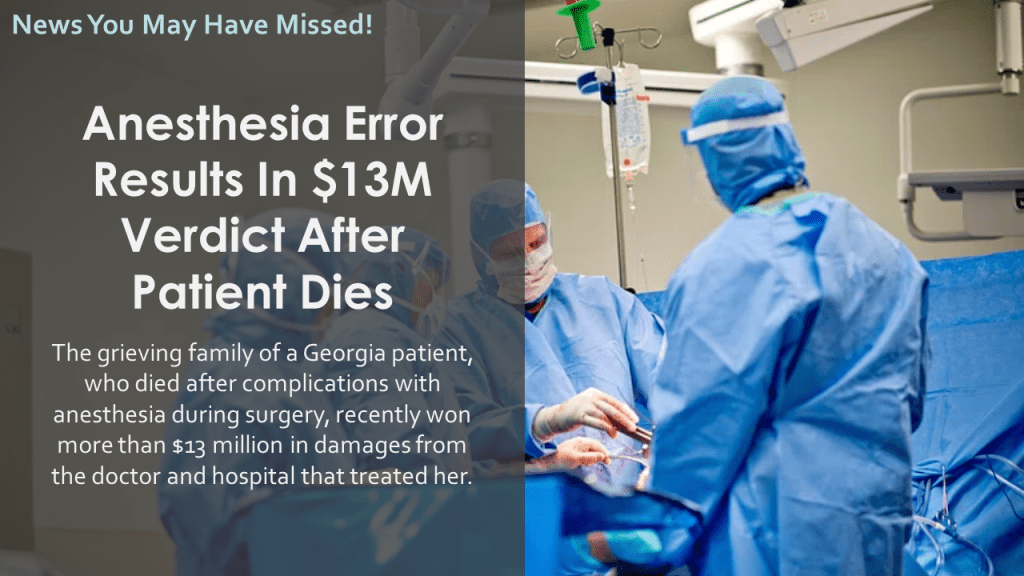
The plaintiff was a morbidly obese patient who sought surgery to address her weight and health problems connected to obesity. However, she allegedly died when an anesthesiologist’s assistant administered too much anesthetic and caused the plaintiff to stop breathing….gillettelaw, Anesthesia Error Results In $13M Jury Verdict After Patient Dies
The patient was later resuscitated, but now she had a serious brain injury and suffered a heart attack. Later, she died while in hospice.
A jury in Bibb County State Court heard her case. According to the jury, the anesthesiologist’s assistant was 82.5% at fault for the death, while the anesthesiologist was 17.5% at fault. The decedent’s family was awarded $775,000 in medical bills, $2.5 million for pain and suffering, and $10.5 million for wrongful death. That totaled $13.75 million.
The decedent, who weighed 337 pounds, underwent an exploratory surgery at Coliseum Health System Northside Hospital on November 14, 2017, to examine the lining of her esophagus, stomach, and intestine prior to undergoing a bariatric surgery. The surgery was designed to help her with her weight loss issues and the comorbidities that came with it. She was supposed to be given monitored anesthesia care throughout the procedure, instead of general anesthesia. Her morbid obesity and obstructive sleep apnea made her “extremely high risk” for airway obstruction while she was sedated.
Her obesity and sleep apnea meant that she lacked the capacity of a healthy patient to withstand a period of several minutes without oxygen. However, her anesthesiologist did not take any additional precautions when administering the anesthetic. In addition, the anesthesiologist failed to tell his assistant about the decedent’s health conditions even though she had performed sedatives on other morbidly obese patients as recently as that afternoon.
After the decedent was given the anesthetic, she immediately stopped breathing. No one noticed until a surgeon alerted her anesthesiologists, and by that point, the decedent’s heart rate had dropped significantly. For eight minutes, she completely lost her pulse. She could not breathe on her own for a period of 14 minutes. Eventually, the doctors were able to resuscitate her using an Ambu bag, a handheld device that helps patients breathe.
The decedent was then diagnosed with hypoxic brain injury and cardiac arrest due to failing to receive oxygen for an extended period of time. For several weeks, she was in a vegetative state. She was taken to another hospital for long-term care. Ultimately, the patient died.