
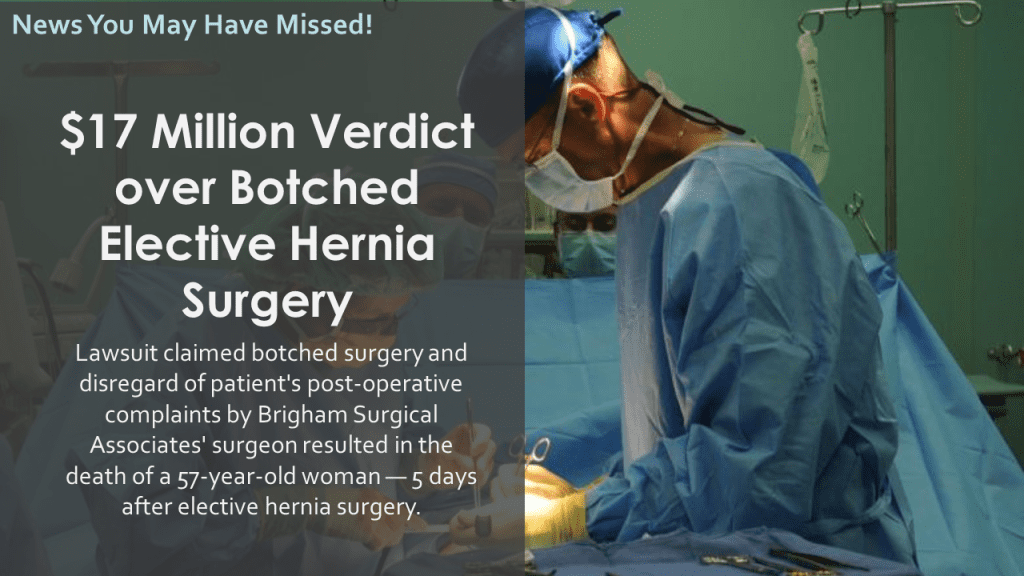
The decedent was a 57-year-old woman, who developed a symptomatic incisional hernia due to prior abdominal surgeries she’d had. She was evaluated by the defendant surgeon, who decided that elective repair was indicated…lubinandmeyer.com, Elective Hernia Surgery Death: $17 Million Verdict in Massachusetts
Surgery was planned to be laparoscopic. At the outset of surgery, the surgeon failed in his attempt to place the Veress needle using a “blind” approach. He thereafter obtained access to the abdominal cavity and began dissecting adhesions between the small bowel and the abdominal wall. Due to these dense adhesions, the surgeon became concerned about potentially perforating the small bowel and converted to open surgery. The surgeon dictated that he completed the repair surgery without incident and that he had inspected the small bowel and found no evidence of injury. The patient was discharged home the same day.
On post-operative day 2, the patient called the surgeon to report increasing abdominal pain, back and shoulder pain, nausea and an inability to eat. The surgeon’s medical assistant, who was not a healthcare provider herself, returned the call and reported that it was normal to have postoperative pain.
The medical assistant emailed the surgeon about the decedent’s call later in the day, but the surgeon did not call the patient back to obtain an adequate medical history. Hours later, the decedent developed difficulty breathing and went to the Emergency Room and was promptly found to be in septic shock. Exploratory surgery found a perforation of the small bowel. Despite efforts to save her, the patient died.
The family testified that the surgeon admitted fault after the small bowel perforation was found. Plaintiff’s counsel elicited expert testimony to establish that the objective medical and laboratory evidence at trial supported the plaintiff’s claim that the full-thickness perforation happened at the time of the original surgery, specifically pointing to blood values at the 2nd hospitalization that could not rise to that degree of abnormality in just a matter of hours as claimed by the surgeon and his expert.
The jury returned a verdict of $17 million.