
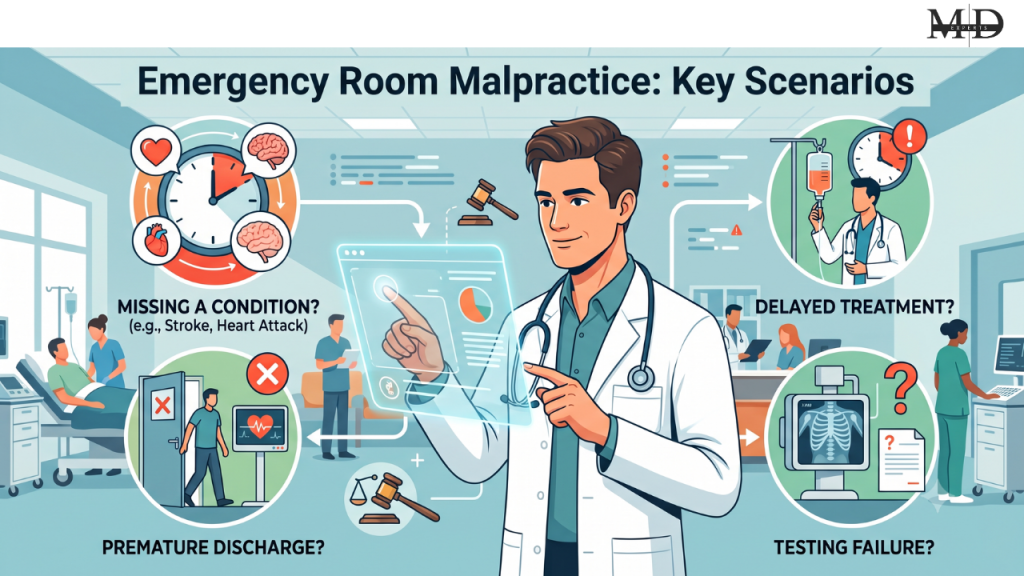
Emergency departments are fast-paced environments where physicians must make important medical decisions quickly, often with incomplete information. When a patient experiences a serious injury or unexpected outcome following emergency care, questions may arise about whether the appropriate standard of care was followed.
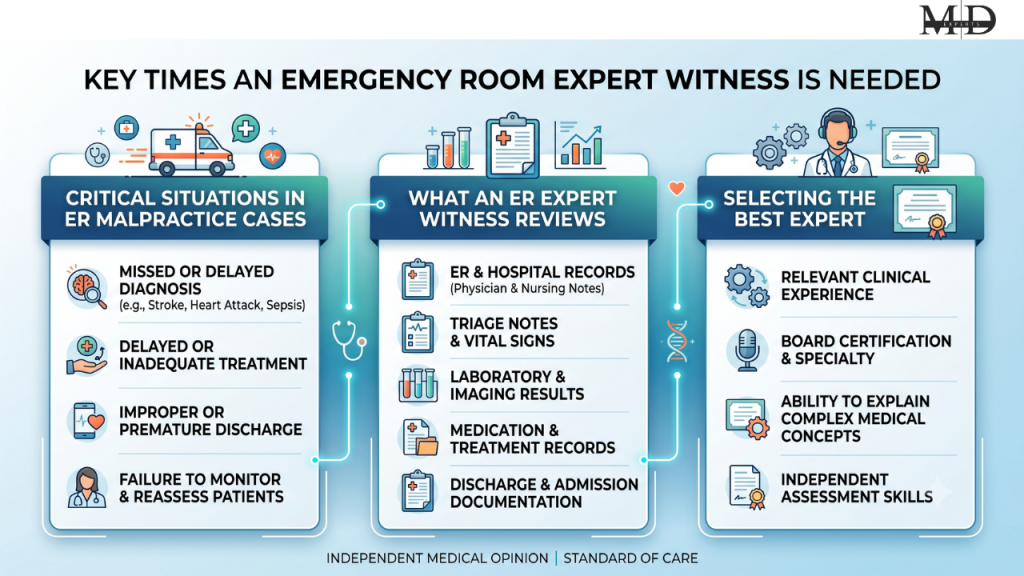
An emergency medicine expert witness can help attorneys understand the medical issues involved in these cases. By reviewing the patient's records and evaluating the care provided, an expert can offer an independent opinion about the clinical decisions made during the emergency department visit.
When Might an ER Expert Witness Be Needed?
An ER expert witness may be valuable when a malpractice claim involves the diagnosis, treatment, monitoring, or disposition of a patient in the emergency department.
Missed or Delayed Diagnosis
Emergency departments commonly evaluate patients with symptoms that may have multiple possible causes. A malpractice claim may allege that a serious condition was missed or diagnosed too late.
Examples can include stroke, heart attack, sepsis, pulmonary embolism, internal bleeding, or other time-sensitive conditions. An emergency department expert witness can review the patient's symptoms, examination findings, test results, and clinical decisions to determine whether the evaluation was consistent with accepted emergency medicine practice.
Improper or Premature Discharge
Another common issue in an emergency room malpractice case is whether the patient should have been discharged, admitted, observed, or transferred.
An emergency room medical expert can assess whether the patient's condition and available clinical information supported the disposition decision and whether appropriate discharge instructions and follow-up recommendations were provided.
Delayed or Inadequate Treatment
A case may also involve allegations that treatment was delayed or that an appropriate medication, procedure, consultation, or intervention was not provided.
An emergency medicine malpractice expert can evaluate the timeline of care and determine whether the treatment provided was appropriate given the patient's symptoms, test results, and changing clinical condition.
Failure to Order Appropriate Testing
Emergency physicians must determine which tests are appropriate based on the patient's presentation. A malpractice claim may question whether additional laboratory testing, imaging, monitoring, or specialist consultation should have been obtained.
An ER malpractice expert witness can evaluate these decisions in the context of the information available to the treating team at the time.
Monitoring, Reassessment, and Communication
Emergency care involves more than the initial physician examination. Triage, nursing assessments, reassessments, monitoring, communication among providers, and responses to changes in a patient's condition may all become relevant to an emergency department malpractice claim.
The appropriate expert depends on the specific allegations and the clinical questions that need to be addressed.
What Does an Emergency Medicine Expert Witness Review?
An emergency medicine expert witness may review:
- Emergency department and hospital records
- Physician and nursing documentation
- Triage notes and vital signs
- Laboratory and imaging results
- Medication and treatment records
- Specialist consultations
- Discharge or admission documentation
- Follow-up and subsequent medical records
The expert may then provide opinions regarding the standard of care, clinical decision-making, and medical causation, depending on the scope of the assignment and the expert's qualifications.
The American College of Emergency Physicians emphasizes that expert testimony concerning emergency medicine should be objective, truthful, and based on generally accepted standards of practice.
How Do You Choose the Right ER Expert?
The right emergency room malpractice expert should have experience that is relevant to the medical issues in the case. Attorneys may consider the expert's specialty, clinical experience, board certification, professional background, and familiarity with the specific type of emergency care involved.
It is also important that the expert can clearly explain complex medical concepts and provide an independent assessment of the care provided.
Not every emergency room claim requires the same type of medical expertise. In some cases, an emergency medicine specialist may be appropriate; in others, a different specialty or subspecialty may be needed based on the patient's condition and the allegations.
How MDExperts Can Help
At MDExperts, we help legal professionals identify and work with qualified medical experts for medical malpractice and other medical-legal matters.
For an emergency room malpractice case, the right medical expert can help clarify whether the emergency department evaluation, diagnosis, treatment, monitoring, or discharge was consistent with accepted medical practice.
If you are reviewing an emergency department malpractice claim and need an ER expert witness, emergency room medical expert, or medical malpractice expert witness, MDExperts can help identify the appropriate clinical expertise for your case.
Contact MDExperts to discuss your case and learn more about our medical expert witness services.
References
- American College of Emergency Physicians - Standard of Care Review
Accessed September 21, 2026 - American College of Emergency Physicians - Clinical Policies
Accessed September 21, 2026 - CMS - Emergency Room Rights and EMTALA
Accessed September 21, 2026 - AHRQ - Diagnostic Errors in the Emergency Department
Accessed September 21, 2026