
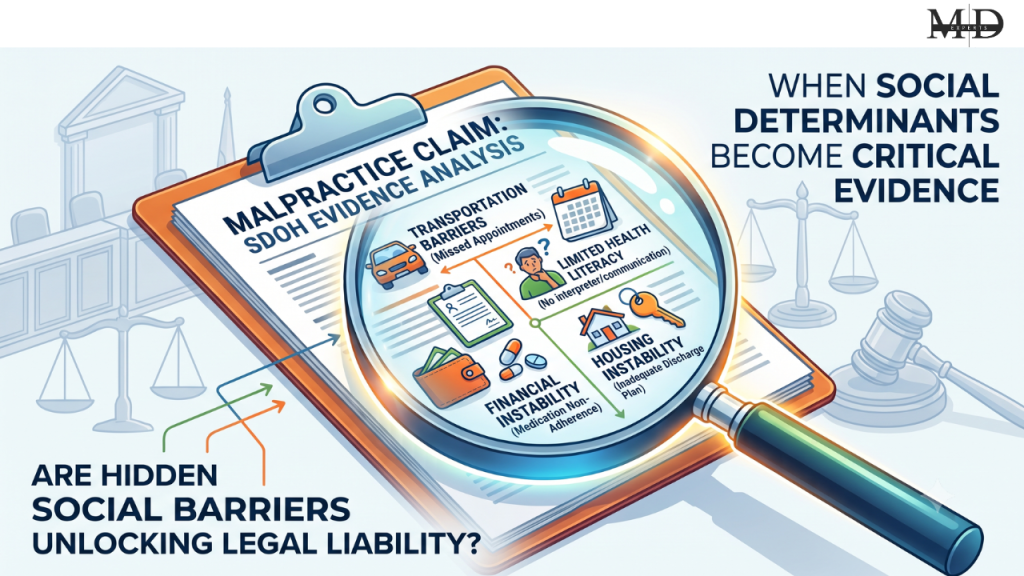
When healthcare providers fail to recognize or appropriately address significant social barriers that affect a patient's care, those omissions may become part of the legal analysis. Today, attorneys, medical experts, and courts are looking more closely at whether providers considered these factors when making clinical decisions, documenting care, and coordinating follow-up.
At MDExperts, our physician experts regularly evaluate complex malpractice claims where documentation, clinical judgment, and patient-specific circumstances—including social determinants—can significantly influence case outcomes.
Understanding Social Determinants of Health
The World Health Organization defines social determinants of health as the non-medical factors that influence health outcomes. These include:
- Economic stability
- Education
- Healthcare access and quality
- Neighborhood and built environment
- Social and community support
These factors often determine whether patients can:
- Obtain prescribed medications
- Attend follow-up appointments
- Understand discharge instructions
- Access transportation
- Afford recommended treatments
- Maintain healthy living conditions
While clinicians cannot eliminate these barriers, recognizing and addressing them appropriately is becoming an increasingly accepted component of quality patient care.
Why Social Determinants Matter in Malpractice Cases
Historically, malpractice litigation focused primarily on clinical decisions and technical medical errors. Today, the conversation has expanded.
Increasingly, attorneys ask questions such as:
- Did the provider identify obvious social barriers?
- Was the patient's inability to follow treatment predictable?
- Were reasonable accommodations made?
- Was care coordinated appropriately?
- Was discharge planning realistic given the patient's circumstances?
These questions illustrate how social determinants malpractice issues can become central to evaluating whether the standard of care was met.
When Social Determinants Become Legal Evidence
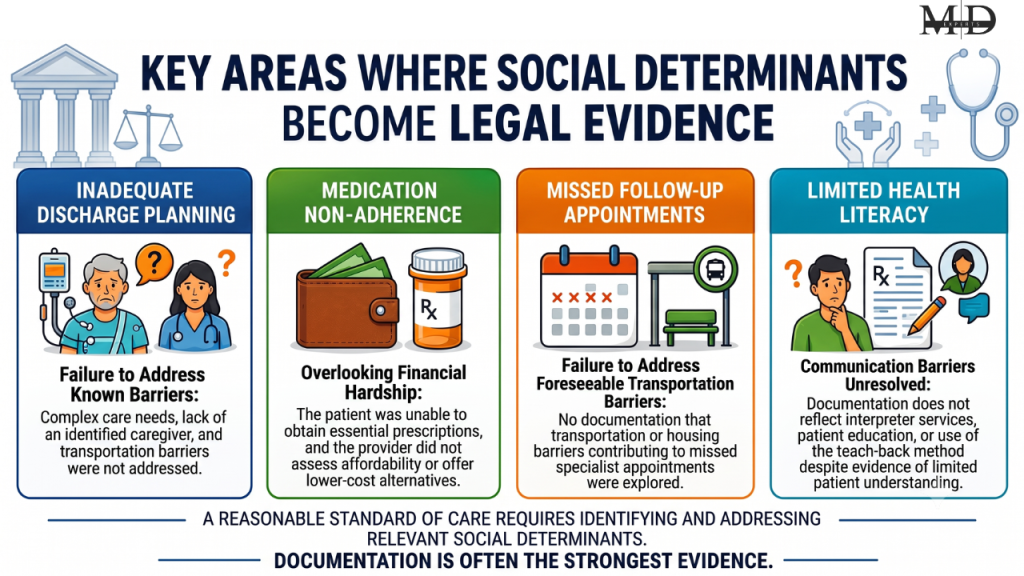
Not every adverse outcome involving social challenges results in liability. However, SDOH legal evidence may become important when documentation or clinical decision-making suggests providers overlooked foreseeable barriers.
Examples include:
Inadequate Discharge Planning
A patient is discharged after surgery with complex wound care instructions but has no caregiver, lacks transportation for follow-up visits, and cannot obtain prescribed supplies.
If these barriers were apparent but not addressed or documented, they may become relevant during litigation.
Medication Non-Adherence
A patient repeatedly fails to fill essential prescriptions due to financial hardship.
If providers never explored affordability, offered alternatives, or documented counseling, opposing experts may argue that foreseeable risks were ignored.
Missed Follow-Up Care
Patients who lack transportation or stable housing frequently miss specialist appointments.
Medical records showing repeated missed appointments without attempts to identify underlying barriers may receive increased scrutiny.
Limited Health Literacy
When patients have difficulty understanding medical instructions because of language barriers or low health literacy, documentation should reflect interpreter services, patient education, or teach-back methods.
Failure to address communication barriers may later become part of social factors medical negligence arguments.
Documentation Is Often the Strongest Evidence
Medical records frequently become one of the most influential pieces of evidence in malpractice litigation.
Strong documentation demonstrates that providers:
- Identified social risks
- Discussed treatment options
- Explained potential consequences
- Coordinated with case management or social workers
- Considered alternative care plans
- Documented patient preferences and decisions
Conversely, absent or incomplete documentation may leave expert reviewers unable to determine whether these considerations occurred.
Health Equity and the Legal Landscape
Healthcare organizations increasingly recognize that improving health equity involves identifying and addressing barriers that affect patient outcomes.
As regulatory agencies and professional organizations continue emphasizing equitable care, litigation is evolving alongside these expectations.
Although health equity litigation is still an emerging area, attorneys increasingly examine whether healthcare systems had processes to identify patients at higher social risk and whether reasonable accommodations were available.
Importantly, malpractice liability is not created simply because a patient experiences social disadvantage. Instead, courts generally examine whether providers acted reasonably under the circumstances while meeting the applicable standard of care.
The Role of Medical Experts
Medical experts play a critical role in determining whether social determinants meaningfully affected clinical care.
Expert reviewers evaluate questions such as:
- Were social barriers clinically relevant?
- Would a reasonably prudent provider have recognized these risks?
- Were appropriate referrals made?
- Was discharge planning adequate?
- Did documentation accurately reflect clinical reasoning?
- Did social factors contribute to the patient's outcome?
These opinions often help attorneys distinguish unavoidable complications from potential departures from the standard of care.
Best Practices for Healthcare Providers
Healthcare organizations can strengthen both patient care and documentation by:
- Screening for social determinants of health when appropriate.
- Documenting identified barriers clearly.
- Using interpreter services when needed.
- Coordinating with social workers or care managers.
- Providing realistic discharge instructions.
- Exploring affordable treatment alternatives.
- Recording shared decision-making discussions.
- Following organizational protocols for high-risk patients.
These practices not only improve patient outcomes but may also provide important context if care is later reviewed during litigation.
Why Expert Review Matters
Every malpractice case is unique. Determining whether social determinants contributed to an adverse outcome requires careful review of the medical records, clinical standards, and patient circumstances.
At MDExperts, our nationwide network of board-certified physician experts provides objective, evidence-based medical opinions across a broad range of specialties. We help attorneys evaluate complex medical records, identify clinically relevant issues, and understand how documentation—including social determinants of health—may influence case analysis.
Contact MDExperts
If you need an independent medical expert to review a malpractice case involving Family Medicine, documentation, discharge planning, health equity considerations, social determinants of health, or other complex clinical issues, MDExperts can help.
Our nationwide network of board-certified physician experts, including experienced Family Medicine specialists, provides objective, evidence-based case reviews to help attorneys evaluate the standard of care and key medical issues.
Contact us today to connect with the right expert and discuss your case.
References
1. World Health Organization - Social Determinants of Health
Accessed August 05, 2026
2. U.S. Department of Health and Human Services - Healthy People 2030 – Social Determinants of Health.
Accessed August 05, 2026
3. Agency for Healthcare Research and Quality (AHRQ) - Social Determinants of Health Database.
Accessed August 05, 2026
4. Centers for Disease Control and Prevention - Social Determinants of Health at CDC.
Accessed August 05, 2026