
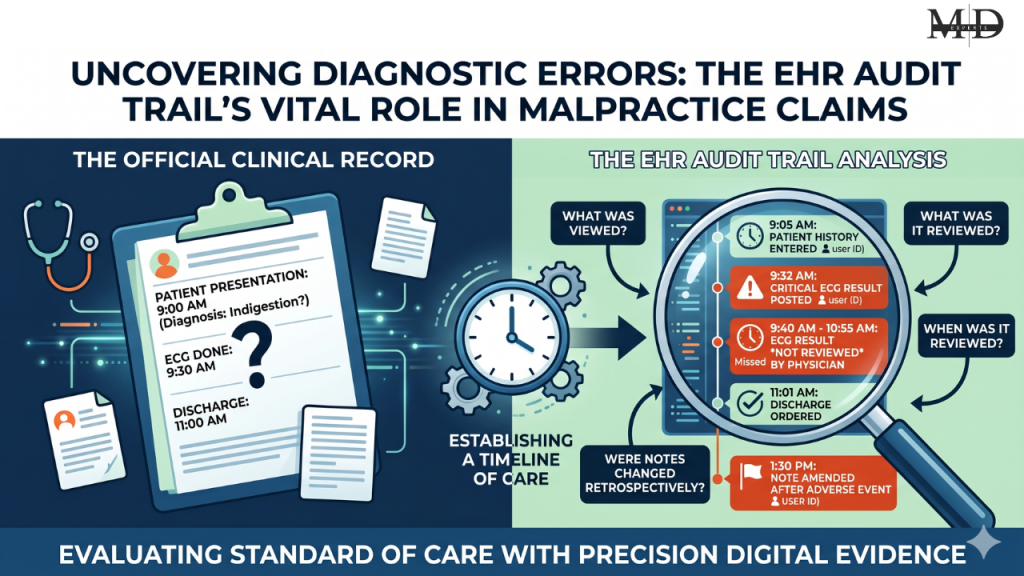
As healthcare has become increasingly digital, Electronic Health Records (EHRs) have transformed how medical evidence is reviewed. Beyond the clinical notes themselves, EHR audit trails provide a detailed, time-stamped record of user activity that can offer valuable insights into clinical decision-making, documentation practices, and care timelines.
This article explores the relationship between standard of care diagnostic errors, malpractice litigation, and the growing importance of EHR audit trails malpractice investigations.
Understanding the Standard of Care in Diagnostic Malpractice Cases
The standard of care refers to the level of care and clinical judgment that a reasonably competent healthcare professional would provide under similar circumstances.
In diagnostic malpractice cases, experts are often asked to determine whether the clinician:
- Obtained an adequate patient history
- Performed appropriate examinations
- Ordered necessary tests
- Properly interpreted diagnostic results
- Communicated findings effectively
- Followed up on abnormal test results
A breach of these responsibilities may constitute a diagnostic malpractice standard violation if it directly contributes to patient injury.
Examples of diagnostic errors that frequently lead to malpractice claims include:
- Failure to diagnose cancer
- Missed stroke diagnosis
- Delayed recognition of sepsis
- Failure to identify cardiac events
- Misinterpretation of radiology or pathology findings
Determining whether a diagnostic error occurred is rarely straightforward. Expert review is essential to assess whether the provider's actions aligned with accepted medical standards at the time of care.
The Growing Impact of EHRs in Medical Malpractice Litigation
Electronic Health Records have become the primary source of clinical documentation in healthcare organizations. While EHRs improve information accessibility and care coordination, they also generate extensive digital evidence.
Today, malpractice cases increasingly rely on electronic health record evidence legal teams can analyze to reconstruct clinical events and evaluate provider actions.
Medical records may reveal:
- Clinical assessments
- Orders and prescriptions
- Test results
- Consultation notes
- Communication among providers
- Documentation timelines
However, the visible chart is only part of the story.
What Are EHR Audit Trails?
An EHR audit trail is a system-generated log that records every interaction with a patient's electronic record. Audit trails typically capture:
- User identification
- Date and time of access
- Records viewed
- Modifications made
- Orders entered
- Documentation updates
- Note sign-offs and amendments
Unlike traditional chart reviews, audit trails provide objective metadata that can reveal exactly when information was accessed or entered into the system. This makes them increasingly valuable in EHR audit trails malpractice investigations.
How EHR Audit Trails Help Evaluate Diagnostic Errors
In malpractice litigation involving diagnostic errors, timing is often critical. Questions frequently arise such as:
- When was a critical lab result available?
- Did the physician review the result?
- Was follow-up action taken promptly?
- Were notes entered in real time or retrospectively?
- Did multiple providers have access to relevant information?
EHR audit trails can help answer these questions by establishing an accurate timeline of care.
For example, an audit trail may reveal:
- A radiology report indicating a serious abnormality was available but not reviewed.
- A laboratory alert was opened but no action was taken.
- Documentation was modified after an adverse event occurred.
- Clinical notes were entered hours or days after patient encounters.
Such findings may support or challenge allegations involving standard of care diagnostic errors.
Establishing the Diagnostic Malpractice Standard Through Expert Analysis
While audit trail data is powerful, it cannot independently determine negligence.
Expert medical review remains essential because specialists must interpret the significance of the information within the clinical context.
When evaluating a potential diagnostic malpractice standard violation, experts consider:
Clinical Decision-Making
Was the provider's diagnostic reasoning consistent with accepted medical practice?
Information Availability
Did the clinician have access to information that should reasonably have altered the diagnosis?
Follow-Up Responsibilities
Were abnormal findings appropriately communicated and addressed?
Documentation Integrity
Do audit trail records align with the documented medical narrative?
The combination of expert testimony and EHR audit trail analysis often provides a more complete picture of whether the standard of care was met.
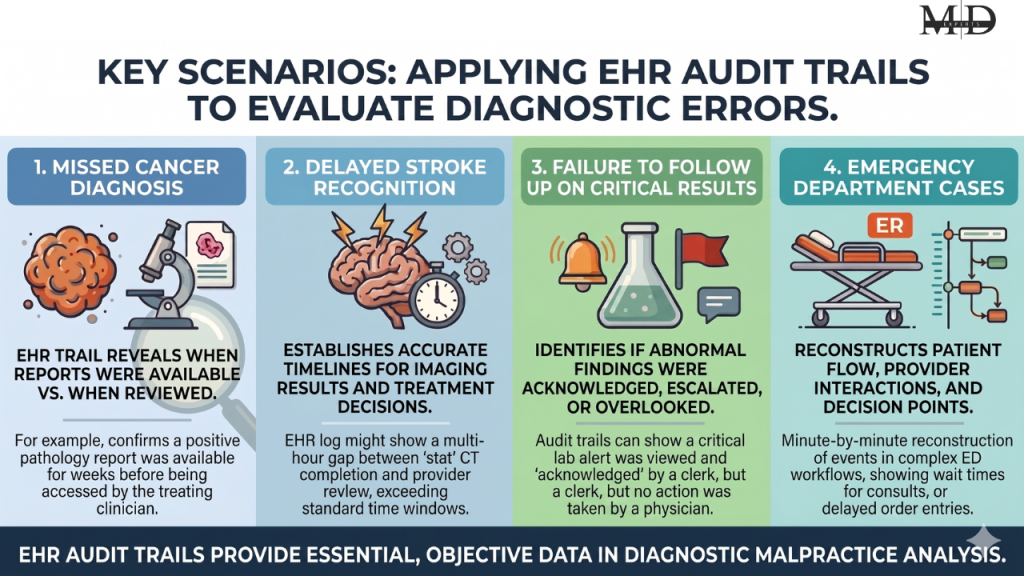
Common Diagnostic Error Scenarios Where Audit Trails Matter
Missed Cancer Diagnoses
Audit trails may show when pathology reports became available and whether providers reviewed them in a timely manner.
Delayed Stroke Recognition
System logs can establish when imaging results were posted and when treatment decisions occurred.
Failure to Follow Up on Critical Results
Audit data may identify whether abnormal findings were acknowledged, escalated, or overlooked.
Emergency Department Cases
Time-stamped records can help reconstruct patient flow, provider interactions, and diagnostic decision points.
In each scenario, electronic health record evidence legal teams analyze may play a significant role in determining liability.
Challenges in Interpreting EHR Audit Trails
Although audit trails provide valuable information, interpretation requires specialized expertise.
Potential challenges include:
- Complex data structures
- Vendor-specific logging systems
- Incomplete metadata
- Distinguishing routine workflow from clinically significant events
- Understanding documentation practices
Without proper analysis, audit trail information can be misunderstood or taken out of context.
This is why medical experts, informatics specialists, and healthcare documentation consultants are often involved in malpractice reviews.
The Role of MDExperts in Standard of Care and Diagnostic Error Analysis
At MDExperts, we provide independent medical expert services that help attorneys, healthcare organizations, and insurers evaluate complex malpractice claims.
Our experts assist with:
- Standard of care reviews
- Diagnostic error analysis
- Medical record evaluation
- EHR documentation review
- Audit trail interpretation
- Expert witness services
- Case merit assessments
By combining clinical expertise with comprehensive record analysis, MDExperts helps clients understand whether a potential breach of the standard of care occurred and how electronic evidence may impact the case.
Conclusion
As healthcare becomes increasingly digital, EHR audit trails are becoming a critical component of malpractice investigations involving diagnostic errors. While traditional medical records remain essential, audit trail data can provide deeper insight into provider actions, documentation timelines, and clinical decision-making processes.
When evaluating standard of care diagnostic errors, the integration of expert medical review and EHR audit trail analysis can significantly strengthen the assessment of liability and causation.
For attorneys, insurers, and healthcare organizations facing complex malpractice matters, understanding the role of EHR audit trails malpractice investigations and electronic health record evidence legal analysis is more important than ever.
Need Expert Assistance?
MDExperts provides experienced medical experts for standard of care reviews, diagnostic malpractice evaluations, and EHR record analysis.
At MDExperts, our network includes experienced specialists across emergency medicine, OB/GYN, neurology, orthopedics, surgery, anesthesiology, hospital medicine, family medicine, radiation oncology, and traumatic brain injury review.
Visit our Contact Page to discuss your case and connect with a qualified expert.
References
1. National Center for Biotechnology Information (NCBI) – Identifying Electronic Health Record Contributions to Diagnostic Error in Ambulatory Settings Through Legal Claims Analysis
Accessed June 22, 2026
2. U.S. Department of Health & Human Services (HHS) – HIPAA Security Rule Guidance
Accessed June 22, 2026
3. Agency for Healthcare Research and Quality (AHRQ) – Diagnostic Safety and Quality Resources
Accessed June 22, 2026