

Family physicians play a critical role in preventive care, chronic disease management, and early diagnosis. Because they are often the first point of contact for patients, they face unique clinical responsibilities—and unique legal risks. While many physicians focus on avoiding obvious medical errors, some of the most significant family medicine malpractice claims arise from issues that are frequently overlooked in everyday practice.
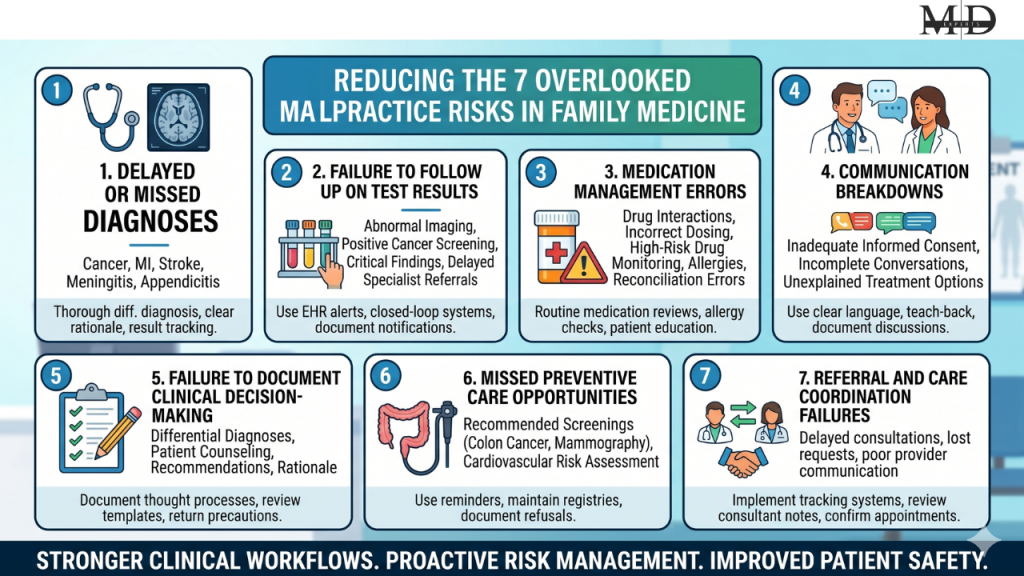
Understanding these hidden vulnerabilities can help reduce primary care litigation risk, improve patient outcomes, and strengthen clinical documentation practices.
1. Delayed or Missed Diagnoses
One of the leading causes of overlooked malpractice cases in family medicine is delayed or missed diagnosis. Primary care physicians often evaluate patients with vague or nonspecific symptoms, making diagnosis particularly challenging.
Common high-risk missed diagnoses include:
• Cancer (breast, colon, lung, prostate)
• Myocardial infarction (heart attack)
• Stroke
• Meningitis
• Appendicitis
A patient presenting with seemingly minor symptoms may later experience a serious outcome, leading to allegations that warning signs were missed or not appropriately investigated.
Risk Reduction Strategies
• Maintain a thorough differential diagnosis.
• Document clinical reasoning clearly.
• Track abnormal test results and referrals.
• Establish follow-up protocols for unresolved symptoms.
2. Failure to Follow Up on Test Results
Ordering diagnostic tests is only one part of patient care. A common source of primary care legal exposure occurs when abnormal test results are not reviewed, communicated, or acted upon in a timely manner.
Examples include:
• Abnormal imaging studies
• Positive cancer screening results
• Critical laboratory findings
• Delayed specialist referrals
Even when a test is properly ordered, failure to ensure follow-up can create substantial liability exposure.
Risk Reduction Strategies
• Use electronic health record (EHR) alerts effectively.
• Create closed-loop communication systems.
• Document patient notification attempts.
• Track pending results until resolution.
3. Medication Management Errors
Family physicians frequently manage patients with multiple chronic conditions and complex medication regimens. As a result, medication-related claims remain a significant category within family medicine malpractice claims.
Potential issues include:
• Drug interactions
• Incorrect dosing
• Failure to monitor high-risk medications
• Allergic reactions
• Medication reconciliation errors during transitions of care
Risk Reduction Strategies
• Conduct routine medication reviews.
• Verify allergies and interactions at every visit.
• Educate patients about medication risks.
• Document monitoring plans and patient instructions.
4. Communication Breakdowns
Many malpractice claims are rooted not only in clinical decisions but also in communication failures.
Patients who feel unheard or inadequately informed are more likely to pursue legal action after an adverse outcome.
Common communication-related risks include:
• Inadequate informed consent discussions
• Failure to explain treatment options
• Miscommunication regarding follow-up care
• Incomplete documentation of patient conversations
Risk Reduction Strategies
• Use clear, patient-friendly language.
• Encourage questions and teach-back methods.
• Document discussions thoroughly.
• Record patient refusals and noncompliance when applicable.
5. Failure to Document Clinical Decision-Making
In malpractice litigation, documentation often becomes the strongest evidence of the care provided.
Unfortunately, physicians may provide appropriate care but fail to adequately document:
• Differential diagnoses
• Patient counseling
• Follow-up recommendations
• Referrals
• Clinical rationale
In many overlooked malpractice cases, the issue is not necessarily poor medical care—it is the inability to demonstrate appropriate clinical judgment through documentation.
Risk Reduction Strategies
• Document thought processes, not just conclusions.
• Record patient education and shared decision-making.
• Note return precautions and follow-up plans.
• Review templates to ensure accuracy and completeness.
6. Missed Preventive Care Opportunities
Preventive medicine is a cornerstone of family practice, but missed screenings can become a significant source of primary care litigation risk.
Examples include:
• Failure to recommend colon cancer screening
• Missed mammography follow-up
• Lack of cardiovascular risk assessment
• Failure to address abnormal screening results
When a preventable disease progresses due to delayed detection, plaintiffs may argue that standard preventive care guidelines were not followed.
Risk Reduction Strategies
• Use preventive care reminders.
• Maintain screening registries.
• Document patient refusals.
• Track overdue preventive services.
7. Referral and Care Coordination Failures
Modern healthcare often requires collaboration between primary care physicians and specialists. When referrals are delayed, incomplete, or poorly coordinated, liability concerns may arise.
Common scenarios include:
• Delayed specialist consultations
• Failure to review consultant recommendations
• Lost referral requests
• Inadequate communication between providers
These situations can significantly increase primary care legal exposure, particularly when a patient's condition worsens during the referral process.
Risk Reduction Strategies
• Implement referral tracking systems.
• Confirm specialist appointments are completed.
• Review consultant notes promptly.
• Communicate findings to patients and document all interactions.
Why Proactive Risk Management Matters
Research consistently shows that diagnostic errors, medication management issues, and communication failures are among the most common drivers of family medicine malpractice claims. While no practice can eliminate risk entirely, physicians can significantly reduce their exposure through stronger clinical workflows, documentation standards, and patient communication practices.
Proactive risk management not only protects providers from litigation but also improves patient safety and quality of care.
How MDExperts Can Help
At MDExperts, we understand the complexities of modern primary care and the challenges physicians face in managing risk while delivering high-quality patient care. Our team provides expert medical review, case analysis, and clinical insights that help healthcare organizations better understand liability trends and improve patient safety outcomes.
If your organization is looking to strengthen risk management strategies or gain expert medical perspectives on complex cases, visit our contact page to connect with the MDExperts team.
Conclusion
Many of the most costly malpractice claims in family medicine stem from issues that appear routine—missed follow-ups, communication gaps, documentation deficiencies, and delayed diagnoses. By recognizing these commonly overlooked risks, family physicians can better protect their patients, their practice, and their professional reputation.
Reducing primary care litigation risk starts with awareness, strong systems, and a commitment to continuous improvement.
Learn more about our Family Medicine expert witness services and how MDExperts can support your case evaluation and litigation needs.
To discuss a case or request an expert review, visit our Contact Page.
References
1. PubMed – Malpractice Risk Prevention for Primary Care Physicians
Accessed June 01, 2026
2. AHRQ PSNet – The Epidemiology of Malpractice Claims in Primary Care
Accessed June 01, 2026
3. National Center for Biotechnology Information – Learning from Malpractice Claims About Negligent Adverse Events in Primary Care
Accessed June 01, 2026
4. National Center for Biotechnology Information – Types and Origins of Diagnostic Errors in Primary Care Setting
Accessed June 01, 2026
5. American Academy of Family Physicians – Documenting High-Risk Cases to Avoid Malpractice Liability
Accessed June 01, 2026