
Sepsis is a medical emergency where every minute counts. When healthcare providers fail to diagnose or treat it promptly, the consequences can be devastating—often leading to organ failure, long-term disability, or death. These cases frequently become the basis of sepsis mismanagement malpractice claims.
But not every adverse outcome result in a viable legal case. Understanding what strengthens—or weakens—a claim is essential for attorneys, insurers, and medical experts alike.
Understanding Sepsis and Why Timing Matters
Sepsis is the body’s extreme response to infection, and it can escalate rapidly into septic shock if untreated. Early intervention—particularly within the “golden hour”—is critical to survival.
Delays in diagnosis or treatment are among the most common triggers for sepsis delay litigation, as even short lapses can drastically worsen patient outcomes.
Common Forms of Sepsis Mismanagement
A successful sepsis mismanagement malpractice claim often centers on identifiable failures in care. These include:
1. Failure to Recognize Sepsis
One of the most frequent allegations is the failure to recognize sepsis despite clear warning signs such as fever, tachycardia, or abnormal lab results.
Healthcare providers are expected to identify early indicators and act swiftly. When they don’t, patients may deteriorate rapidly.
2. Delayed Diagnosis or Treatment
Delays are at the heart of many sepsis delay litigation cases. Examples include:
• Not ordering timely blood cultures or lactate tests
• Delayed administration of antibiotics
• Failure to escalate care to ICU when needed
Even a few hours’ delay can significantly increase mortality risk.
3. Inadequate Monitoring or Follow-Up
Patients discharged with abnormal vital signs or without proper monitoring plans often return in critical condition.
This pattern is commonly cited in malpractice claims, especially when deterioration was predictable and preventable.
4. Misdiagnosis or Underestimation
Sepsis is frequently mistaken for less serious conditions like flu or gastroenteritis.
Such misdiagnoses contribute heavily to failure to recognize sepsis claims, particularly when red flags were present but ignored.
The Legal Foundation: Proving a Sepsis Malpractice Case
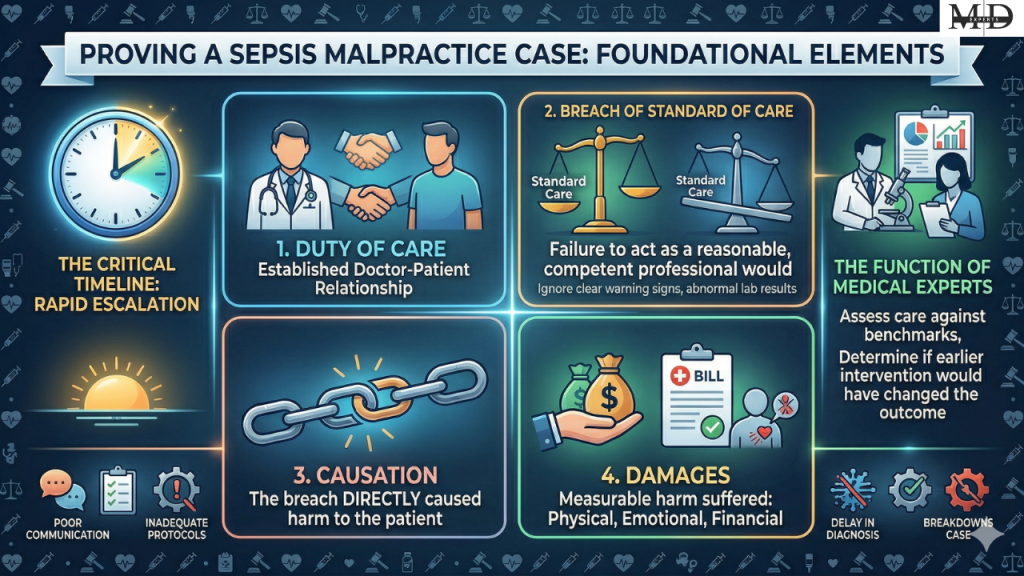
To succeed in a sepsis standard of care legal claim, four core elements must be established:
1. Duty of Care
A doctor-patient relationship must exist.
2. Breach of Standard of Care
The provider failed to act as a reasonably competent professional would under similar circumstances.
3. Causation
The breach directly caused harm to the patient.
4. Damages
The patient suffered measurable harm—physical, emotional, or financial.
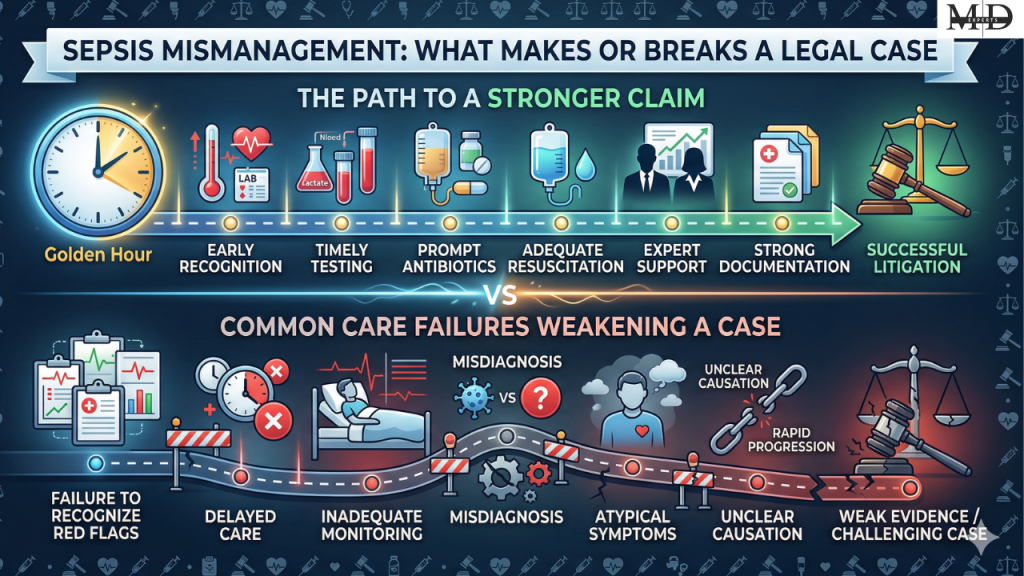
The sepsis standard of care legal benchmark typically includes:
• Early recognition of symptoms
• Timely diagnostic testing
• Prompt antibiotic administration
• Adequate fluid resuscitation
• Continuous monitoring and escalation
Failure in any of these areas may constitute negligence.
What Strengthens a Sepsis Litigation Case
Certain factors significantly improve the chances of a successful claim:
• Clear documentation of delayed treatment
• Evidence of abnormal vitals ignored or overlooked
• Lack of adherence to established sepsis protocols
• Expert testimony linking delay to patient harm
• Severe or permanent injury (e.g., organ failure, amputation)
Cases where providers missed obvious warning signs are often considered strong from a legal standpoint.
What Weakens a Case
Not all poor outcomes are due to malpractice. A case may be harder to prove when:
• Symptoms were atypical or non-specific
• Rapid deterioration occurred despite appropriate care
• Documentation shows adherence to protocols
• Causation between delay and outcome is unclear
Sepsis can progress aggressively even with proper treatment, which can complicate litigation.
The Critical Role of Medical Experts
Given the complexity of sepsis cases, expert review is essential. Medical experts help determine whether the sepsis standard of care legal threshold was breached and whether earlier intervention would have changed the outcome.
At MDExperts, our our hospitalist team plays a critical role in evaluating inpatient care, identifying delays, and assessing whether there was a failure to recognize sepsis in time.
Why These Cases Are Increasing
Heightened awareness of sepsis protocols and patient safety standards has led to increased scrutiny of healthcare providers.
Today, sepsis mismanagement malpractice claims often focus on system failures—such as poor communication, inadequate protocols, or breakdowns in monitoring—not just individual negligence.
How MDExperts Can Help
At MDExperts, we specialize in providing independent, evidence-based medical expert opinions for complex cases, including sepsis delay litigation and failure to recognize sepsis claims.
Our team of experienced physicians can:
• Evaluate adherence to sepsis protocols
• Identify deviations from the standard of care
• Provide detailed medico-legal reports
• Support litigation with credible expert testimony
Contact MDExperts today to strengthen your case with trusted medical insights.
Conclusion
Sepsis cases are uniquely time-sensitive and medically complex. In legal terms, success often hinges on one central question:
Could earlier recognition or treatment have prevented harm?
When the answer is yes—and supported by evidence—a strong sepsis mismanagement malpractice case emerges. When it’s unclear, litigation becomes far more challenging.
Understanding these nuances is key to building—or defending—a case effectively.
References
1. CDC – Clinical Care for Sepsis
Accessed March 31, 2026
2. WHO – Guidelines on the Clinical Management of Sepsis
Accessed March 31, 2026
3. WHO – Improving Prevention, Diagnosis and Clinical Management of Sepsis
Accessed March 31, 2026
4. WHO – Clinical Care Systems for Sepsis
Accessed March 31, 2026
5. PubMed Central – Sepsis Definition and Treatment Guidelines Review
Accessed March 31, 2026
6. CDC – Hospital Sepsis Program Core Elements
Accessed March 31, 2026