
In medicine, timing is often the difference between recovery and irreversible harm. Minutes matter in stroke care. Hours matter in sepsis. Weeks matter in cancer treatment. While not every delay is negligent, some delays fall outside accepted malpractice timelines standards—and when patient harm follows, legal exposure may arise.
For attorneys evaluating delayed diagnosis malpractice, treatment delay negligence, or broader delay in care legal liability, understanding how courts assess medical timing across specialties is critical.
At MDExperts, we routinely analyze complex cases where the central issue is not what treatment was provided—but when.
Not Every Delay Is Negligence
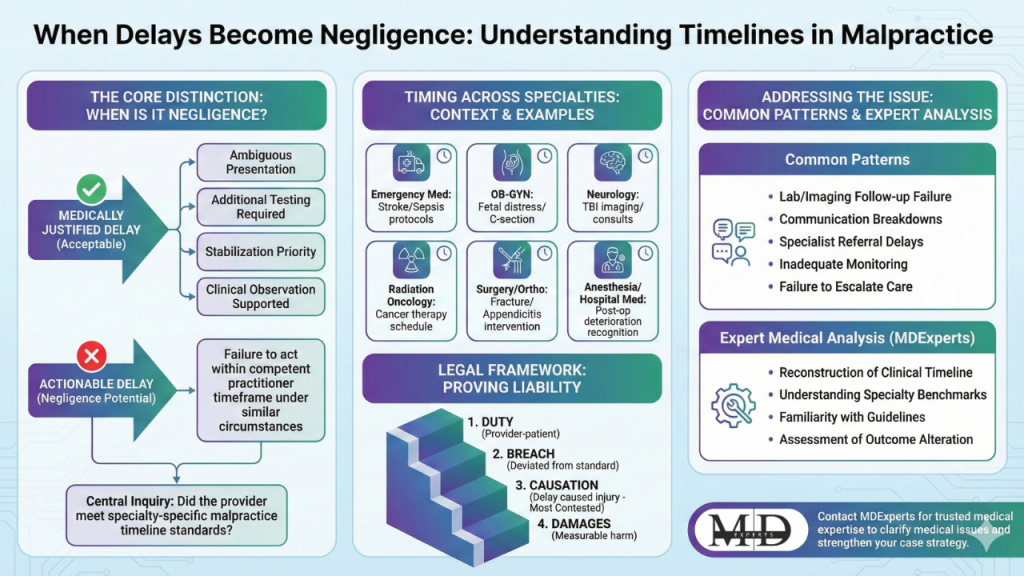
Healthcare is dynamic and often unpredictable. Providers must prioritize patients, assess evolving symptoms, and operate within real-world system constraints. A delay may be medically justified if:
• The patient’s presentation was ambiguous
• Additional testing was reasonably required
• Stabilization took priority over definitive treatment
• Clinical judgment supported observation
However, a delay may become actionable when a provider fails to act within a timeframe that reasonably competent practitioners would follow under similar circumstances.
That standard varies depending on clinical context.
Timing Across Specialties: Why Context Matters
Although the legal principles are universal, expectations around timing differ across fields such as Emergency Medicine, OB-GYN, Neurology, Radiation Oncology, Orthopedics, General Surgery, Anesthesia, Family Medicine, and Hospital Medicine.
For example:
• In emergency departments, failure to timely recognize stroke symptoms or initiate sepsis protocols can quickly evolve into treatment delay negligence claims.
• In obstetrics, delayed response to non-reassuring fetal heart tracings or postponement of a necessary cesarean section may trigger allegations of delayed diagnosis malpractice if neonatal injury results.
• In neurology and traumatic brain injury cases, delays in imaging or neurosurgical consultation may significantly impact long-term neurological outcomes.
• In radiation oncology, postponement of cancer therapy or interruptions in treatment schedules may raise questions about disease progression and survival impact.
• In orthopedic or general surgery cases, delayed intervention for fractures, internal bleeding, appendicitis, or compartment syndrome can dramatically alter outcomes.
• In anesthesia and hospital medicine settings, delayed recognition of postoperative deterioration, airway compromise, or abnormal vital signs may form the basis for delay in care legal liability.
Despite these differences, the central legal inquiry remains consistent:
Did the provider act within accepted malpractice timelines standards for their specialty?
The Legal Framework: Proving Delay in Care Liability
To establish delay in care legal liability, four elements must generally be proven:
1. Duty – A provider-patient relationship existed.
2. Breach – The provider deviated from accepted malpractice timelines standards.
3. Causation – The delay directly caused or materially worsened the patient’s injury.
4. Damages – The patient suffered measurable harm.
Causation is often the most contested element. Even if a delay occurred, the key question becomes:
Would earlier intervention more likely than not have changed the outcome?
In many delayed diagnosis malpractice cases, defense experts argue that disease progression was inevitable. Plaintiffs must demonstrate that earlier detection or treatment would have provided a meaningful clinical advantage.
That determination requires specialty-specific expertise and careful timeline reconstruction.
The Importance of Expert Medical Analysis
Evaluating treatment delay negligence requires more than reviewing timestamps. It demands:
• A clear reconstruction of the clinical timeline
• Understanding of specialty-specific benchmarks
• Familiarity with peer-reviewed guidelines
• Assessment of whether earlier action would have altered prognosis
At MDExperts, we provide board-certified, specialty-matched physicians across Emergency Medicine, OB-GYN, Neurology, Radiation Oncology, Orthopedics, General Surgery, Anesthesia, Family Medicine. Our experts analyze whether a delay truly represents a deviation—or whether the care met accepted standards given the circumstances.
If you are reviewing a matter involving delayed diagnosis malpractice, treatment delay negligence, or potential delay in care legal liability, the team at MDExperts can help clarify the medical issues at the center of your case.
Contact MDExperts today for trusted medical expertise that strengthens your case strategy.
References
1. National Academy of Medicine – Diagnostic Error in Health Care
Accessed February 25, 2026
2. Agency for Healthcare Research and Quality (AHRQ) – Patient Safety Network – Diagnostic Errors
Accessed February 25, 2026
3. World Health Organization (WHO) – Patient Safety
Accessed February 25, 2026