
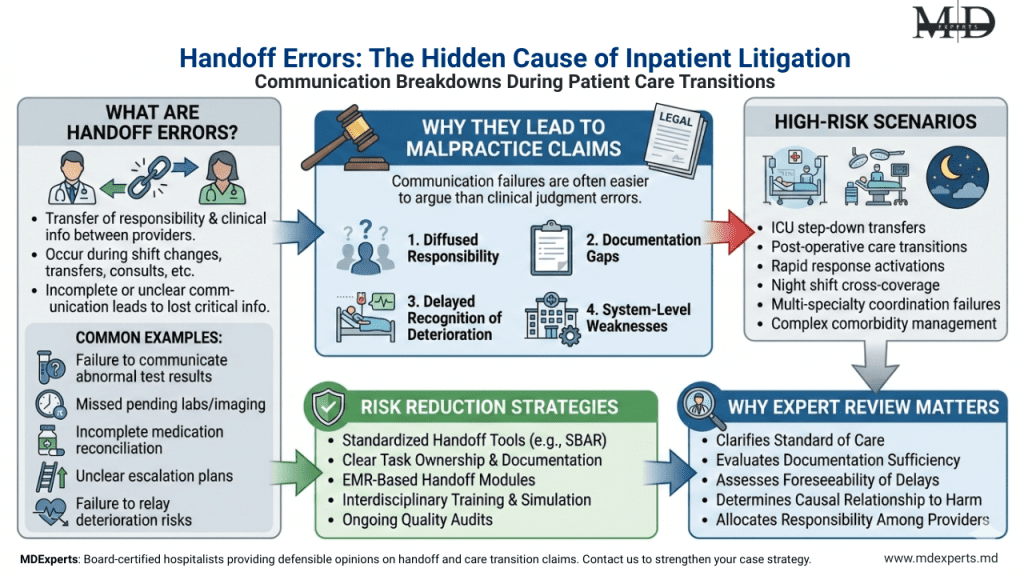
In today’s hospital environment, patient care is rarely managed by a single physician. Hospitalists , specialists, consultants, residents, nurses, and ancillary staff all play a role in managing complex inpatient cases. While this collaborative model improves access and efficiency, it also increases the risk of communication breakdowns.
Handoff errors malpractice claims are emerging as a significant driver of inpatient litigation. Often, the root cause is not a technical mistake in treatment — but a failure in communication during care transitions.
What Are Handoff Errors?
A “handoff” occurs whenever responsibility and clinical information about a patient are transferred from one provider to another. These transitions happen frequently in inpatient settings:
• Shift changes
• ICU-to-floor transfers
• Emergency department admissions
• Specialist consultations
• Weekend or night coverage
• Discharge planning
When communication during these transitions is incomplete or unclear, critical information can be lost.
Common examples include:
• Failure to communicate abnormal test results
• Missed pending labs or imaging
• Incomplete medication reconciliation
• Unclear escalation plans
• Failure to relay patient deterioration risks
These breakdowns often lead to inpatient communication failures that result in delayed treatment, preventable complications, or serious harm.
Why Handoff Errors Lead to Malpractice Claims
In litigation, communication failures are often easier to argue than clinical judgment errors. When documentation is incomplete or responsibility is ambiguous, plaintiffs’ attorneys may frame the issue as hospital handoff negligence.
1. Diffused Responsibility
When multiple providers are involved, accountability may become unclear. If no one explicitly owns a pending task, it may go unaddressed.
2. Documentation Gaps
Courts rely heavily on the medical record. In many handoff errors malpractice cases, inadequate documentation becomes a focal point.
3. Delayed Recognition of Deterioration
Many care transitions liability claims involve a patient whose condition worsened after transfer because the receiving team was not fully informed of clinical concerns.
4. System-Level Weaknesses
Hospitals without standardized handoff protocols may face institutional liability in addition to individual provider exposure.
The Unique Role of the Hospitalist in Care Transitions
The Hospitalist plays a central role in coordinating inpatient care. Hospitalists frequently assume responsibility from emergency physicians, communicate with consulting specialists, oversee daily management, and manage discharge planning — placing them at the heart of high-risk transitions.
Because hospitalists oversee longitudinal inpatient management, they are often named in cases involving:
• Missed follow-up on abnormal findings
• Transfer-related delays
• Failure to communicate consultant recommendations
• Weekend or cross-coverage oversights
Given their coordinating function, allegations of inpatient communication failures and hospital handoff negligence frequently involve hospital-based physicians.
At MDExperts, we provide board-certified hospitalist experts who understand the practical realities of inpatient workflow, documentation standards, and communication protocols. Their insights are critical when evaluating complex handoff errors malpractice and care transitions liability claims.
High-Risk Scenarios for Care Transitions Liability
Certain inpatient situations carry elevated litigation risk:
• ICU step-down transfers
• Post-operative care transitions
• Rapid response activations
• Night shift cross-coverage
• Multi-specialty coordination failures
• Complex comorbidity management
In these settings, even minor communication gaps can have serious downstream consequences.
Risk Reduction Strategies
Hospitals and providers can mitigate exposure by strengthening handoff systems:
Standardized Handoff Tools
Frameworks such as SBAR (Situation, Background, Assessment, Recommendation) reduce variability.
Clear Task Ownership
Explicit documentation of who is responsible for pending results and follow-up actions.
EMR-Based Handoff Modules
Electronic tools that ensure structured information transfer.
Training and Simulation
Interdisciplinary training reinforces consistency.
Ongoing Quality Audits
Monitoring handoff processes identifies system vulnerabilities early.
By proactively addressing communication risks, institutions can reduce both patient harm and care transitions liability exposure.
Why Expert Review Matters in Handoff Errors Malpractice Cases
Handoff-related litigation often involves complex, multi-provider scenarios. Determining whether a breach occurred requires nuanced clinical analysis.
Expert review can clarify:
• Whether communication met the standard of care
• Whether documentation was sufficient
• Whether delays were foreseeable
• Whether harm was causally related to the alleged communication failure
• Allocation of responsibility among providers
At MDExperts, we specialize in evaluating inpatient communication failures and hospital handoff negligence claims. Our network includes experienced hospitalists and specialists who provide objective, defensible opinions grounded in real-world inpatient practice.
If you are handling a case involving alleged handoff errors malpractice, our team can assist with thorough case review, expert reports, and testimony support.
Contact MDExperts today for trusted medical expertise that strengthens your case strategy.
Conclusion
As inpatient care becomes increasingly team-based, communication during transitions is one of the most legally vulnerable points in the continuum of care.
Handoff errors may be invisible in the moment — but in litigation, they are highly scrutinized. By strengthening communication protocols and engaging qualified experts when disputes arise, providers and institutions can better protect both patients and their legal standing.
MDExperts is here to support you.
References
1. AHRQ Patient Safety Primer: Handoffs and Signouts — Agency for Healthcare Research and Quality
Accessed February 11, 2026
2. Clinical Evidence: Structured Handoff Review (PubMed summary) – National Library of Medicine
Accessed February 11, 2026
3. Transitions in Care and Patient Safety – National Library of Medicine
Accessed February 11, 2026