
In the world of family medicine, delivering high-quality continuous care means more than diagnosing conditions and prescribing medications. It requires vigilant care coordination, appropriate referrals to specialists, and consistent follow-up on patient progress. When these crucial elements break down, they become not just clinical failures but major sources of medical liability.
Why Referral Failures Matter in Family Medicine
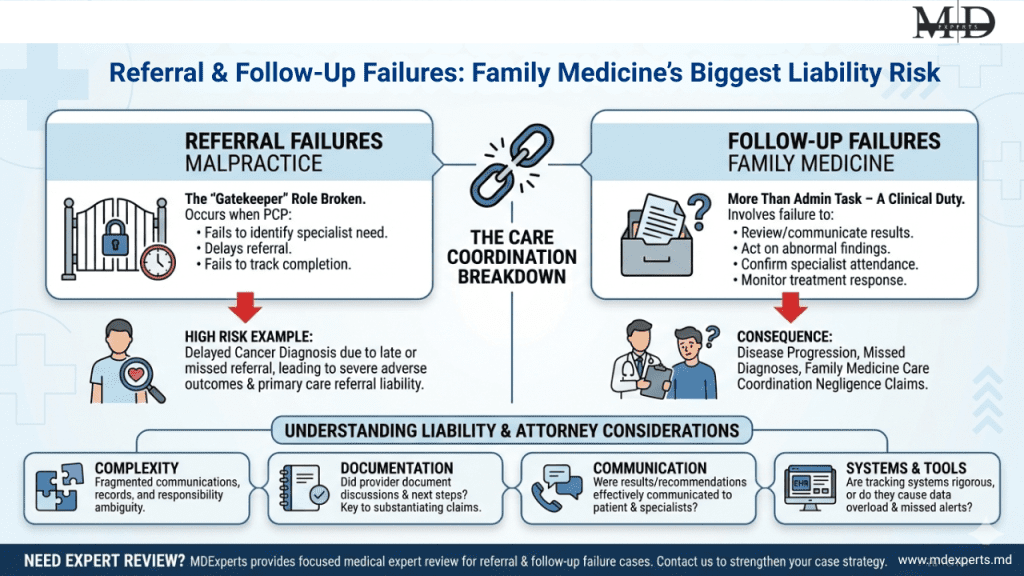
Referral failures malpractice claims often arise when a primary care provider (PCP) does not appropriately identify the need for specialist evaluation, fails to make the referral promptly, or fails to take reasonable steps to follow up when a patient does not complete the referral. Family medicine physicians serve as gatekeepers in a patient’s healthcare journey. Their role in guiding patients to the right specialist at the right time is essential, especially in complex or evolving conditions.
Research demonstrates that when referrals are delayed or never occur, the risk of adverse patient outcomes increases significantly, and with it, the potential for primary care referral liability. A delayed cancer diagnosis that could have been prevented with timely referral is one of the most striking examples.
The Hidden Risks of Follow-Up Failures in Family Medicine
Equally concerning are follow up failures family medicine cases, where a clinician fails to track or act upon diagnostic tests, specialist feedback, or patient symptoms. Follow-up is not a passive administrative task — it is a clinical responsibility.
Important aspects of effective follow-up include:
• Ensuring test results are reviewed and communicated
• Acting on abnormal findings
• Confirming that patients attend referred specialist appointments
• Monitoring treatment response
Failure in any of these areas can lead to progression of disease, missed diagnoses, and ultimately, family medicine care coordination negligence claims.
Understanding the Liability Landscape
Medical malpractice claims related to referral failures malpractice and follow-up errors are among the most complex. Unlike procedural errors with clear time stamps and outcomes, these cases often involve:
• Patient communications across multiple settings
• Fragmented medical record documentation
• Ambiguity about who was responsible for next steps
For attorneys handling such cases, it is vital to understand both the clinical standards expected of family medicine providers and the documentation needed to substantiate claims of negligence.
AI and Digital Tools — Solution or New Risk?
Electronic health records (EHRs), referral tracking systems, and patient portals hold promise for reducing lapses in care continuity. However, without rigorous protocols and training, these systems can also contribute to missed alerts, overlooked messages, and data overload — further complicating primary care referral liability concerns.
Real-World Examples of Risk Zones
Cases involving:
• Abnormal lab results not communicated or followed up
• Specialty referrals not tracked to completion
• Missed imaging due to lack of alerts
• Poor coordination during transitions of care (e.g., from hospital to outpatient clinic)
These situations frequently appear in claims associated with family medicine care coordination negligence.
What Attorneys Should Look For
When evaluating potential malpractice cases related to family medicine referral or follow-up failures, key considerations include:
• Was there a clear indication for referral or further evaluation?
• Did the provider document discussions about recommended next steps?
• Were results and recommendations communicated effectively?
• Were there reasonable systems in place for tracking referred care?
Expert testimony often hinges on whether accepted standards of care were met — not just in decision making, but in communication and coordination.
Why Partner with MDExperts
At MDExperts, we provide focused medical expert review from board-certified specialists experienced in evaluating referral failures malpractice, follow up failures family medicine, and broader issues of family medicine care coordination negligence.
Our experts help attorneys by:
• Clarifying complex clinical timelines
• Identifying deviations from accepted care standards
• Providing defensible, well-supported reports
• Offering credible testimony
Contact MDExperts today for trusted medical expertise that strengthens your case strategy.
References
1. Continuity and coordination of care practice brief : World Health Organization Accessed February 09, 2026
2. Referral process gaps and incomplete specialist follow-up: AAFP News article
Accessed February 09, 2026
3. Continuity of care definition and role: American Academy of Family Physicians
Accessed February 09, 2026
4. Primary care practices often lack reliable systems to track test results and ensure follow-up
Accessed February 09, 2026