
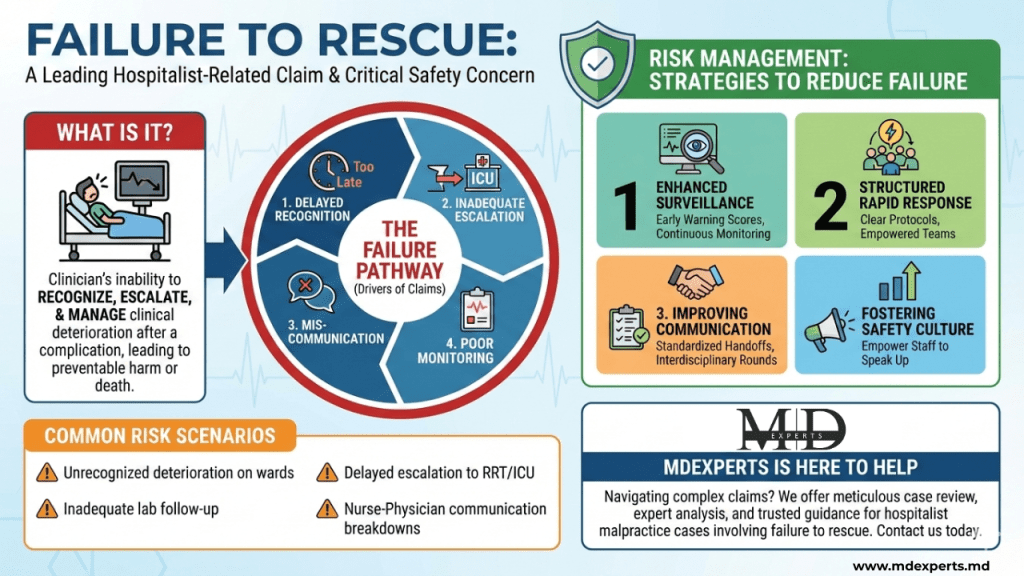
In modern hospital care, failure to rescue has emerged as a critical safety concern — and a leading driver of hospitalist claims . This concept refers to a clinician’s inability to recognize, escalate, and appropriately manage a patient’s clinical deterioration following a complication. When this occurs, preventable morbidity or mortality may result, exposing hospitalists and hospitals to significant liability and harm.
What Is Failure to Rescue?
Failure to rescue medical error describes the situation when a hospitalized patient experiences a complication — whether from disease progression or a medical intervention — and clinicians fail to intervene in time to prevent a serious outcome, including death. It’s not simply the occurrence of an adverse event but the inability to rescue a patient from that event.
Research shows that failure to rescue is a key indicator of quality in hospital care and strongly correlates with institutional mortality differences. Hospitals with optimal monitoring, teamwork, and rapid response systems tend to have lower failure-to-rescue rates.
Why Failure to Rescue Drives Hospitalist Malpractice Claims
Hospitalists are on the front lines of inpatient care. When complications occur — such as sepsis, postoperative issues, or deterioration unrelated to the initial problem — hospitalists are responsible for early recognition, escalation, and management.
Unfortunately, when this process fails, the consequences can be catastrophic, and patients or families often pursue legal action based on:
• Delayed recognition of clinical deterioration
• Inadequate escalation to intensive care or specialists
• Miscommunication between care teams
• Poor monitoring of vital signs or test results
Such failures frequently translate into hospitalist malpractice claims because they are perceived as departures from the accepted standard of care.
Hospitalist Liability: Risk Factors and Common Scenarios
Although research on hospitalist-specific claims is limited, available data indicate that errors in clinical judgment, delayed treatment, inadequate monitoring, and miscommunication are common contributors to liability. These issues overlap directly with failure to rescue medical error events.
Common hospital scenarios tied to failure to rescue include:
• Unrecognized deterioration on wards
• Delayed escalation to rapid response teams or ICU
• Inadequate follow-up on abnormal labs
• Communication breakdowns between nurses and physicians
Each represents a potential pathway to both clinical harm and a malpractice claim. Since many of these events build over hours before critical intervention is sought, effective hospitalist risk management must focus on early detection and rapid action.
Hospitalist Risk Management: Strategies to Reduce Failure to Rescue
Reducing failure to rescue isn’t solely about avoiding claims — it’s about improving patient outcomes through systems-based improvements that also reduce liability:
1. Enhanced Surveillance and Monitoring
Utilizing early warning scores and continuous monitoring helps clinicians detect deterioration earlier — giving hospitalists the time needed to act.
2. Structured Rapid Response Systems
Rapid response teams and clear escalation protocols empower staff to act swiftly when a patient shows signs of decline.
3. Improving Communication and Teamwork
Structured handoffs, standardized communication tools, and interdisciplinary rounds reduce misunderstandings that can contribute to delayed rescue.
4. Fostering a Culture of Safety
Institutions with strong safety cultures — where staff feel empowered to speak up and escalate concerns — show lower failure-to-rescue rates.
Each of these components is a pillar of effective hospitalist risk management, helping to minimize both adverse events and the malpractice risk that follows.
Why MDExperts Is Here to Help
At MDExperts, we understand the intricate connection between clinical practice, patient safety, and legal risk. Failure to rescue cases and other medical malpractice hospitalist claims are complex, often involving nuanced reviews of timelines, monitoring data, and standards of care.
If you’re navigating a potential hospitalist malpractice claim — whether on behalf of a patient, family, or provider — MDExperts offers meticulous case review, expert analysis, and trusted guidance at every stage.
Contact us today to learn how we can support you.
References
• Failure to Rescue - Rapid Response Systems.
Agency for Healthcare Research and Quality (AHRQ), Making Healthcare Safer IV.
Accessed January 12, 2026.
• Failure to Rescue: A Quality Indicator for Postoperative Care
National Library of Medicine, PubMed.
Accessed January 12, 2026.
• What Is a Failure to Rescue Medical Malpractice Lawsuit?
Gray, Ritter & Graham, P.C.
Accessed January 12, 2026.
• Medical Malpractice: Causes and Outcomes of Claims Against Hospitalists
Society of Hospital Medicine.
Accessed January 12, 2026.
• Tackling the Underlying Problems of Failure to Rescue
The Hospitalist.
Accessed January 12, 2026.