
Cancer remains one of the most frequent and high-risk conditions cited in malpractice claims involving primary care physicians. Although many types of malpractice allegations exist—medication errors, procedural issues, treatment complications—the most common involve missed or delayed diagnosis, and cancer is a standout example.
From a medicolegal perspective, these cases often hinge on testimony from a primary care expert witness or medical expert witness in family medicine to explain whether the standard of care was met.
Diagnostic Error: The Core Problem in Primary Care
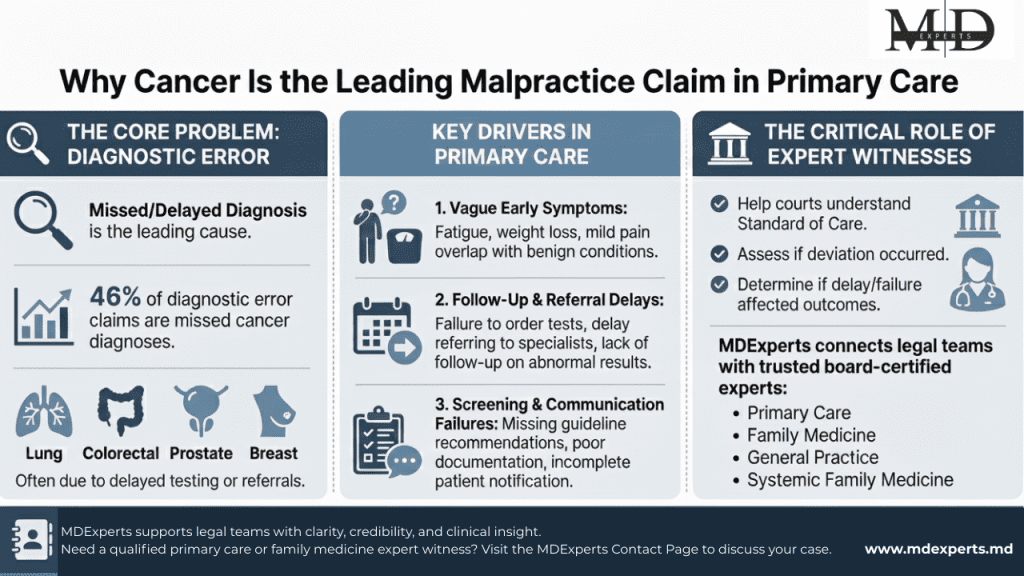
A key factor behind cancer-related malpractice claims is diagnostic error. Studies examining closed malpractice claims in outpatient general medicine show that missed cancer diagnoses are the leading type of diagnostic error in primary care. In one analysis of more than 2,000 diagnostic error claims, missed cancer diagnoses accounted for about 46% of these cases—particularly lung, colorectal, prostate, and breast cancers—often due to delayed testing or referrals.
Diagnostic errors in ambulatory settings are not rare. Large observational studies suggest that at least 5% of adults in outpatient care experience a diagnostic error, underscoring how common these issues are in everyday family practice environments.
Why Cancer Claims Are So Common in Primary Care
1. Vague Early Symptoms
Many cancers present with non-specific symptoms like fatigue, weight loss, or mild pain—symptoms that overlap with benign conditions. Such ambiguity makes early detection difficult, and in legal proceedings, a family physician expert witness or family doctor expert witness may be brought in to determine whether appropriate clinical suspicion and follow-up testing were indicated.
Diagnostic error libraries consistently identify cancer as one of the chief diagnostic failures across healthcare settings, often due to missed subtle findings or delayed action.
2. Follow-Up and Referral Delays
Many malpractice claims involve breakdowns after the initial visit, including:
• Failure to order necessary diagnostic tests
• Delay in referring to specialists
• Lack of follow-up on abnormal results
Analyses of primary care malpractice data show that errors in test ordering or consultation referrals are common components of missed cancer cases. In these matters, attorneys rely on a general practice expert witness or systemic family medicine expert to evaluate both individual clinical decisions and broader practice-level systems.
3. Screening and Risk Stratification Errors
Cancer screening guidelines change over time, and missing guideline-recommended screening can contribute to delayed diagnosis. These issues are especially important in malpractice cases where plaintiffs allege failure to adhere to accepted screening protocols.
Major guideline bodies such as the U.S. Preventive Services Task Force (USPSTF) publish up-to-date cancer screening recommendations that are routinely relied upon in standard-of-care analyses.
Communication and Documentation Failures
Many cancer malpractice claims are rooted not just in clinical judgment, but in poor documentation and communication. Missing evidence of patient notification, inadequate tracking systems, and incomplete shared decision-making documentation all increase legal exposure.
The National Academy of Medicine highlights that failures in diagnostic follow-up and communication are major contributors to diagnostic error-related harm.
The Critical Role of Expert Witnesses
Cancer malpractice claims are often medically and legally complex. Attorneys typically secure experts such as:
•
Medical expert witness family medicine specialists
•
Family practice expert witnesses
•
Primary care expert witnesses
•
Family physician expert witnesses
These professionals help courts understand:
• The accepted standard of care
• Whether a deviation occurred
• Whether a delay or failure made a difference in patient outcomes
Their assessments can be decisive in both plaintiff and defense strategies.
How MDExperts Supports Cancer-Related Litigation
At MDExperts, we specialize in connecting legal teams with board-certified, actively practicing physicians who serve as trusted expert witnesses in cancer-related primary care malpractice cases.
Our vetted experts include:
• Medical expert witnesses in family medicine
•
Family doctor expert witnesses
•
General practice expert witnesses
•
Systemic family medicine experts
Need a Qualified Primary Care or Family Medicine Expert Witness?
Visit the MDExperts Contact Page to discuss your case and be matched with the right expert.
Conclusion
Cancer remains a leading type of malpractice claim in primary care because of the inherent challenges in diagnosing it early, the nuances of appropriate screening and follow-up, and the real-world limitations in systems and communication. As demand for accurate expert interpretation grows, so does the importance of partnering with a reliable primary care expert witness .
MDExperts is proud to support legal teams across the United States with trusted family medicine and general practice expert witnesses who bring clarity, credibility, and clinical insight to cancer-related malpractice cases.
References
1. Missed diagnosis of cancer in primary care
2. The frequency of diagnostic errors in outpatient care
3. Diagnostic Error
4. USPSTF guideline library
5. National Academies Press overview on diagnostic error