
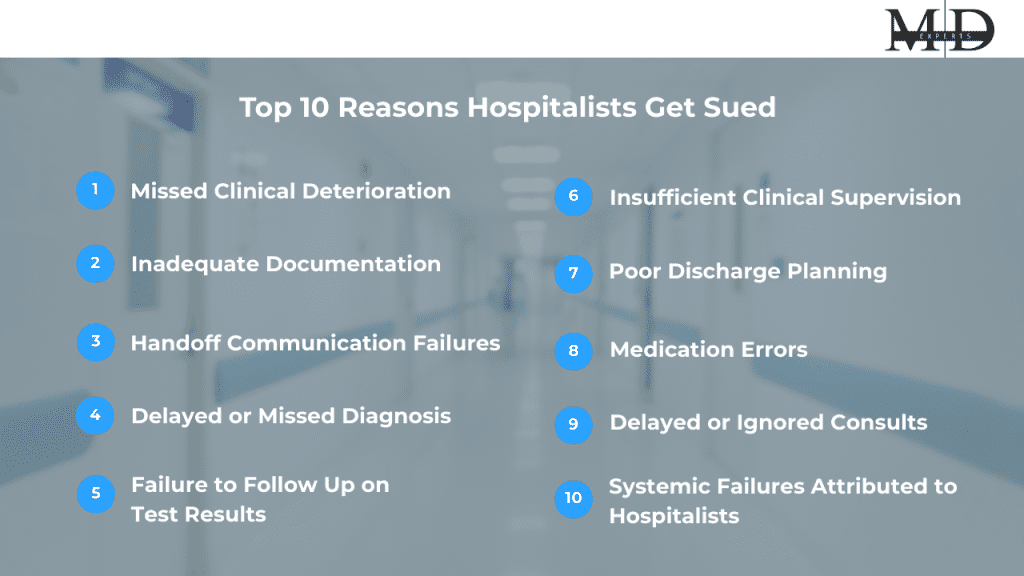
Hospitalists practice in one of the most complex, fast-paced environments in modern medicine. Managing acutely ill patients, coordinating with multiple specialties, and navigating systemic hospital pressures significantly increases medico-legal risk. As a result, hospitalists are frequently named in malpractice lawsuits—often involving systemic failures in hospital care rather than individual negligence.
Drawing on insights commonly identified by a hospitalist expert witness, this blog outlines the top 10 reasons hospitalists get sued and practical strategies to reduce liability exposure.
1. Failure to Recognize or Escalate Clinical Deterioration
Why lawsuits happen:
Missed early warning signs of sepsis, stroke, respiratory failure, or cardiac events are among the most common allegations. Plaintiffs often rely on a hospitalist standard of care expert to demonstrate delayed recognition or escalation.
How to prevent it:
• Use standardized early warning scores
• Document reassessments clearly
• Escalate promptly and document consultant communication
An expert review of hospitalist records often reveals missed opportunities for timely intervention.
2. Inadequate Documentation
Why lawsuits happen:
Poor documentation can make appropriate care appear negligent. In litigation, “if it’s not documented, it didn’t happen” is a prevailing principle used by a hospitalist malpractice expert witness.
How to prevent it:
• Clearly document medical decision-making
• Record differential diagnoses and rationale
• Note patient refusals and informed consent discussions
Strong documentation is one of the most effective legal defenses.
3. Communication Failures During Handoffs
Why lawsuits happen:
Shift changes, weekend coverage, and cross-coverage errors are frequently cited in malpractice claims. A systemic hospitalist expert witness often identifies breakdowns in handoff communication.
How to prevent it:
• Use structured handoff tools (e.g., SBAR)
• Ensure critical issues are highlighted
• Confirm understanding with receiving providers
Many claims stem from systemic failures in hospital care, not individual incompetence.
4. Delayed or Missed Diagnosis
Why lawsuits happen:
Failure to diagnose conditions such as PE, bowel obstruction, intracranial hemorrhage, or sepsis remains a leading cause of litigation. Plaintiffs frequently seek a hospitalist negligence expert witness to establish deviation from expected care.
How to prevent it:
• Maintain broad differentials
• Reassess when patients fail to improve
• Document diagnostic reasoning thoroughly
5. Failure to Follow Up on Test Results
Why lawsuits happen:
Abnormal labs, imaging, or consultant recommendations that are overlooked can lead to severe patient harm.
How to prevent it:
• Track pending studies at discharge
• Document acknowledgment of critical values
• Establish reliable result-review systems
An expert review of hospitalist records often focuses heavily on missed results.
6. Inadequate Supervision of APPs or Residents
Why lawsuits happen:
Hospitalists are often named in lawsuits involving NPs, PAs, or residents they supervise. A hospitalist medical expert witness may evaluate whether appropriate oversight occurred.
How to prevent it:
• Clearly define supervisory roles
• Document oversight and availability
• Personally assess high-risk patients
7. Poor Discharge Planning and Transitions of Care
Why lawsuits happen:
Premature discharge, inadequate instructions, or failure to arrange follow-up care frequently result in readmissions or adverse events.
How to prevent it:
• Ensure clear discharge summaries
• Confirm medication reconciliation
• Communicate with outpatient providers
A hospitalist case evaluation expert often identifies discharge failures as pivotal events.
8. Medication Errors
Why lawsuits happen:
Incorrect dosing, failure to adjust for renal function, drug interactions, or missed allergies are common allegations.
How to prevent it:
• Review medication lists carefully
• Use clinical decision support tools
• Document rationale for high-risk medications
9. Delayed Consultations or Failure to Act on Consultant Advice
Why lawsuits happen:
Not consulting specialists when indicated—or ignoring their recommendations—can be portrayed as negligence by a hospitalist expert witness.
How to prevent it:
• Consult early for complex cases
• Document discussions and recommendations
• Explain deviations from consultant advice
10. Systemic Hospital Failures Attributed to the Hospitalist
Why lawsuits happen:
Staffing shortages, overcrowding, EHR failures, and delayed diagnostics are increasingly blamed on individual providers. A systemic failures in hospital care expert is often required to differentiate individual versus institutional responsibility.
How to prevent it:
• Document resource limitations
• Escalate safety concerns through proper channels
• Advocate for patient safety in real time
The Role of Expert Review in Hospitalist Malpractice Cases
Whether you are defending a claim or pursuing one, the involvement of a board-certified hospitalist expert witness is critical. A qualified expert can:
• Conduct an expert review of hospitalist records
• Provide objective hospitalist case evaluation
• Analyze adherence to the hospitalist standard of care
• Identify individual versus systemic failures
Why MDExperts Is the Trusted Choice
At MDExperts, we specialize in connecting attorneys with highly qualified hospitalist expert witnesses, including:
• Board-certified hospitalist expert witnesses
• Hospitalist malpractice expert witnesses
• Hospitalist negligence expert witnesses
• Systemic hospitalist expert witnesses
Our experts deliver credible, defensible opinions rooted in real-world inpatient medicine and evidence-based standards of care.
Need a Hospitalist Expert Witness?
If you require a hospitalist medical expert witness, expert record review, or case evaluation, MDExperts is here to help.
Contact MDExperts today to speak with our team and secure the right expert for your case.